An Android app costs anywhere from a few thousand dollars for a simple, single-purpose app to well over $100,000 for a complex product with a backend, payments and an admin panel. The two things that move the number most are scope (how many features and screens) and who builds it (a freelancer, an agency, or your own team, in which country). This guide gives you ranges you can plan with, a feature-by-feature table, the costs people forget, and a worked example you can adapt.
Every figure below is a typical estimate, not a quote. We built them from effort in hours multiplied by hourly rates, and we state both so you can check our arithmetic and swap in your own numbers. If you want a number for your own idea, the app cost calculator does the same maths in your currency.
What does Android app development cost in 2026?
Start with effort, because price is just effort times rate. We use three tiers of app complexity.
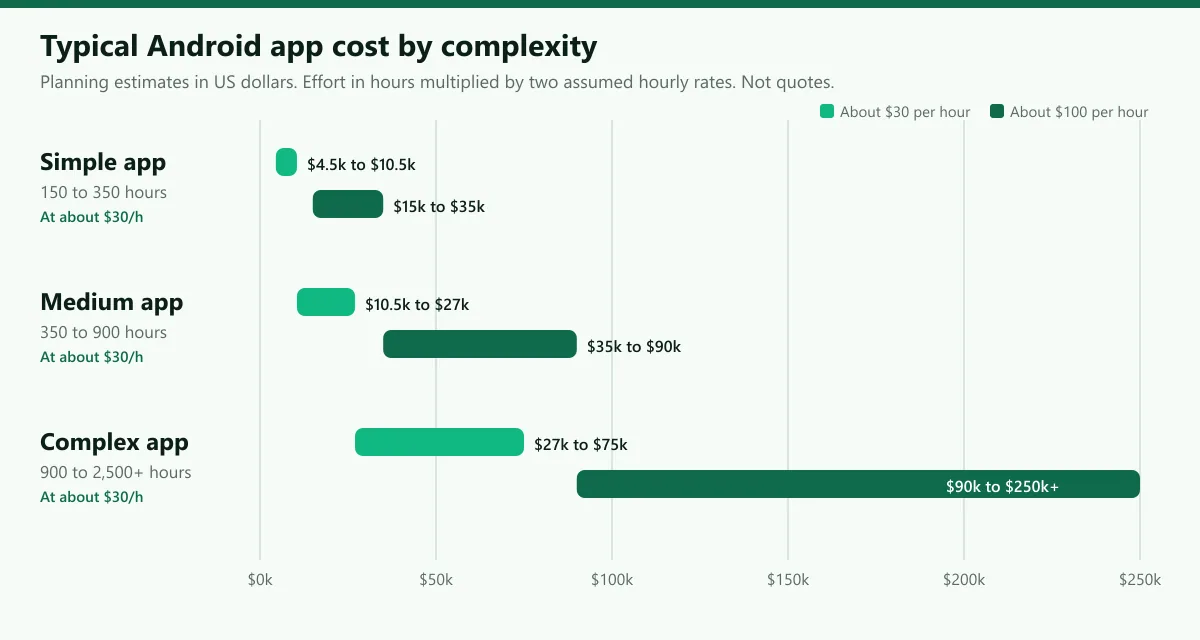
| App type | What it usually includes | Effort | At about $30/h | At about $100/h |
|---|---|---|---|---|
| Simple | 5 to 10 screens, no backend or a very light one, local storage, basic design | 150 to 350 hours | $4,500 to $10,500 | $15,000 to $35,000 |
| Medium | Accounts, an API or Firebase backend, push notifications, payments or subscriptions, polished design | 350 to 900 hours | $10,500 to $27,000 | $35,000 to $90,000 |
| Complex | Custom backend, admin panel, real-time features, several integrations, offline sync, scale and security work | 900 to 2,500+ hours | $27,000 to $75,000+ | $90,000 to $250,000+ |
Assumptions: the effort includes design, development, testing and release, but not marketing. The two hourly rates are planning assumptions that stand for lower-cost and high-cost markets; they are not survey data.
A flashlight, a unit converter or a single-quiz app sits in the simple tier. A booking app with accounts, reminders and an admin dashboard is medium. A marketplace, a telehealth platform or a social app is complex.
What affects the cost most
Features
Each feature carries a typical block of effort. These are the ones we see change a budget the most.
| Feature | Typical effort | At about $30/h | At about $100/h |
|---|---|---|---|
| Login and accounts (email, Google sign-in) | 20 to 60 hours | $600 to $1,800 | $2,000 to $6,000 |
| Payments and subscriptions (Google Play Billing) | 30 to 80 hours | $900 to $2,400 | $3,000 to $8,000 |
| Push notifications | 15 to 40 hours | $450 to $1,200 | $1,500 to $4,000 |
| Maps and location | 25 to 70 hours | $750 to $2,100 | $2,500 to $7,000 |
| Offline mode and sync | 40 to 120 hours | $1,200 to $3,600 | $4,000 to $12,000 |
| AI features (using a provider's API) | 40 to 150 hours | $1,200 to $4,500 | $4,000 to $15,000 |
| In-app chat | 80 to 200 hours | $2,400 to $6,000 | $8,000 to $20,000 |
| Admin panel (web) | 80 to 250 hours | $2,400 to $7,500 | $8,000 to $25,000 |
Two lines deserve a note. Chat looks small on a feature list and is large in practice: message delivery, read states, media, moderation and notifications all need work. The admin panel is a second product. If you need to manage users, content or orders without a developer, it is a web application with its own design, security and testing.
Design
A custom interface takes real design time. A template-based design is cheaper, but an app that is meant to stand out needs original screens, a component set and a handful of iterations. Plan roughly 10 to 15 percent of the total for design on a typical project, more if you need a brand identity as well. Our UI/UX design service covers this step.
Native, cross-platform and iOS
Building natively for Android in Kotlin gives the best access to the platform. A cross-platform framework can lower the cost of shipping on both Android and iOS from one codebase, and it has its own trade-offs. We compare them in Kotlin vs Flutter. If iOS is on your roadmap, say so before the quote, because it changes the architecture decision.
Cost by team type
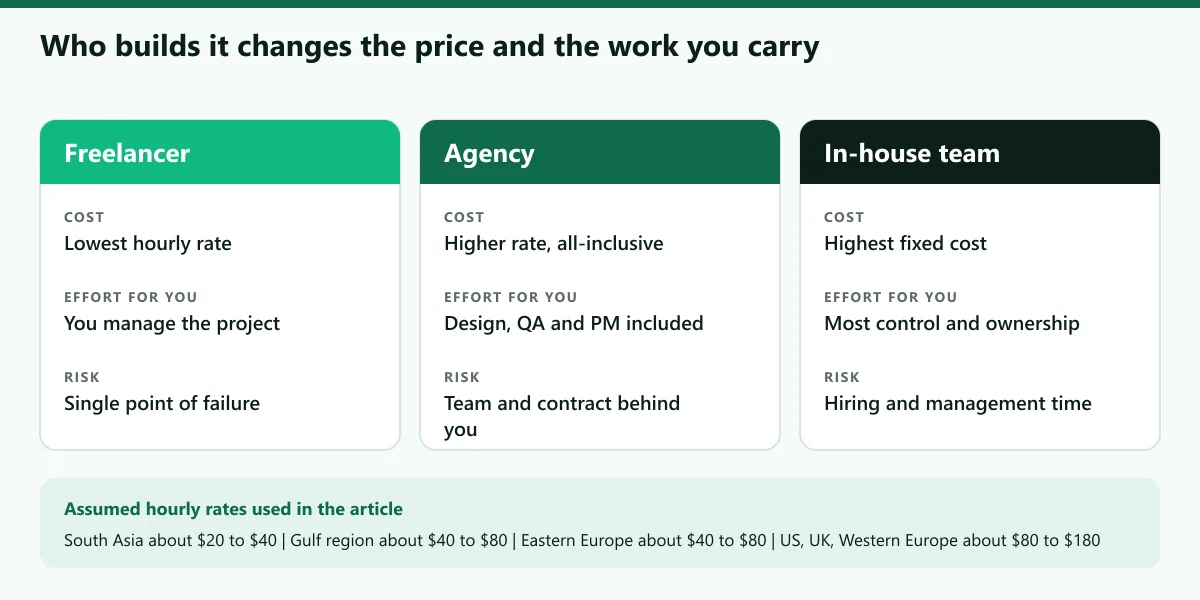
- Freelancer. Usually the lowest rate and a fast start. You carry the project management, and there is key-person risk if they become unavailable. A good fit for a small, well-defined app.
- Agency. A higher hourly rate that includes design, QA, project management and a team behind the delivery. A good fit for medium and complex apps and for anyone who needs a contract, a schedule and support after launch.
- In-house team. The most control and the highest fixed cost. Salaries, hiring time, tools and management mean it only makes sense when software is a core, long-term part of your business.
Regional rates
Rates differ a lot by market, and the table shows the planning ranges we use in this article. They are assumptions for budgeting, not survey results.
| Where the team is based | Assumed hourly rate range |
|---|---|
| South Asia (for example Pakistan, India) | about $20 to $40 |
| Gulf region (for example Saudi Arabia, the UAE) | about $40 to $80 |
| Eastern Europe | about $40 to $80 |
| US, UK and Western Europe | about $80 to $180 |
If you are working out the cost to build an app in Pakistan, scope is still the main driver. A medium app of 600 hours is about $12,000 at $20/h and about $24,000 at $40/h, and local proposals are often quoted in rupees. We cover both markets on our pages about app development in Pakistan and Saudi Arabia. A lower rate does not mean lower quality, and a higher rate does not guarantee it. Judge a team by shipped apps, references and how clearly they scope your project.
The costs people forget
The build is only part of the bill.
- Google Play Console fee. A one-time registration fee of US$25, paid by credit or debit card, according to the official Play Console guide. Prepaid cards are not accepted.
- Servers and services. Hosting, a database, file storage, push notification and email services. A small app can run on modest or free tiers; a growing one cannot. Budget for it monthly.
- Maintenance and updates. Android changes every year. Google Play requires new apps and updates to target a recent Android version: from August 31, 2026, new apps and updates must target Android 16 (API level 36), according to the Google Play target API requirements. As a planning assumption, not an industry figure, we suggest setting aside roughly 15 to 25 percent of the build cost per year for maintenance, library updates and fixes.
- Third-party licences. Maps, analytics, AI APIs and some SDKs charge by usage.
- Legal documents. A privacy policy and a deletion page are required for most apps. Our privacy policy generator gives you a starting template for both.
- Marketing and store optimisation. Downloads do not arrive on their own. Even a modest budget for the store listing and early promotion pays back; see our ASO guide.
- Support. Someone has to answer user emails and review reports.
A worked example: an appointment-booking app
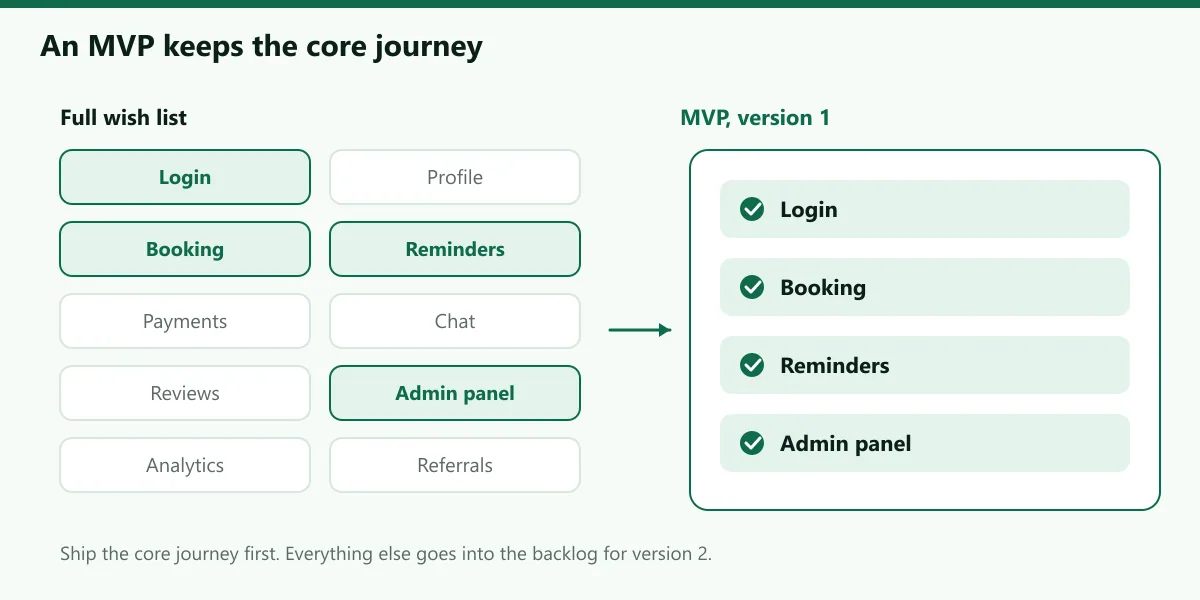
Take a clinic that wants an Android app for patients to book appointments. The scope is login, a list of services and doctors, appointment booking, push reminders, and a web admin panel for the reception team. There is no online payment in version one.
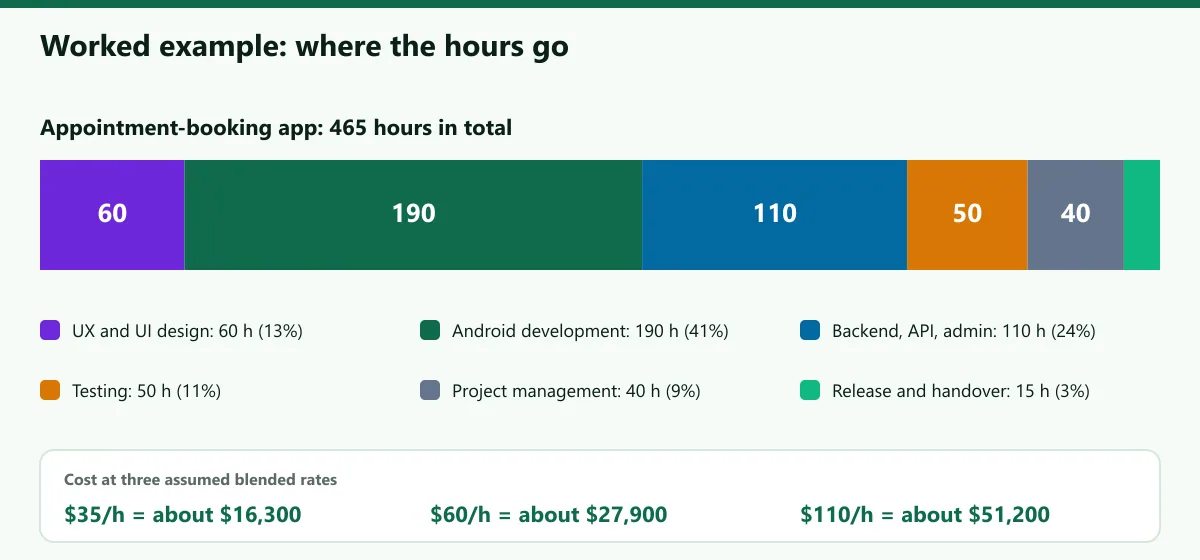
| Activity | Hours |
|---|---|
| UX and UI design | 60 |
| Android development (Kotlin) | 190 |
| Backend, API and admin panel | 110 |
| Testing and bug fixing | 50 |
| Project management | 40 |
| Release, store listing and handover | 15 |
| Total | 465 |
At the three assumed blended rates the cost is:
- About $16,300 at $35 per hour.
- About $27,900 at $60 per hour.
- About $51,200 at $110 per hour.
The spread is the point of the example. The scope is identical; the budget differs by a factor of three because of the team. Add the first year of servers, maintenance and a small marketing budget on top, and the all-in first-year figure is higher than the build cost alone.
How to reduce the cost without cutting corners
- Build an MVP first. List every feature, then keep only what a first user needs to get the core value. Everything else becomes version two.
- Choose a backend that fits. Managed services such as Firebase can cut backend effort for many apps. A custom backend pays off when you need unusual logic or full control.
- Reuse proven components. Authentication, payments and notifications have mature libraries. Do not build them from scratch.
- Fix the scope, then protect it. Changes mid-project are the most common cause of overruns. Agree what is in version one and put new ideas in a backlog.
- Write a clear brief. A precise brief is cheaper to quote and to build. Our project brief generator walks you through it.
- Decide on iOS early. Retrofitting a second platform is more expensive than planning for it.
What a good quote looks like
A useful quote names the scope, lists what is excluded, shows hours or milestones, states who owns the code, and explains how changes are handled. It also says what happens after launch: bug fixes for an agreed period, and the cost of updates. If a number looks much lower than the others, ask what has been left out. If you want us to scope your idea, our Android development service starts with a short conversation and a written estimate.
Frequently asked questions
Sources

Written by
Hamza Fazal
CTO, DEESU
Muhammad Hamza Fazal is the CTO of DEESU. An Android and full-stack web developer and digital marketer based in Islamabad, he builds the apps and platforms behind DEESU's engineering work.
More from HamzaFree tools for this topic
Need help with this?