
Imagine an attacker knocking your entire production API cluster offline—not with a 100 Gbps DDoS flood, not with a zero-day kernel exploit, but with a single 42-character string pasted into a signup email field or a Markdown comment box. Within milliseconds, your Node.js container spikes to 100% CPU, health checks time out, Kubernetes restarts the pod in a crash loop, and every concurrent user on that instance hangs indefinitely.
This attack is Regular Expression Denial of Service (ReDoS), driven by catastrophic backtracking. It has brought down global infrastructure at Cloudflare, Stack Overflow, and dozens of major npm packages (semver, minimatch, validator, marked, and ua-parser-js have all patched high-severity ReDoS CVEs). Because regular expressions look deceptively concise in pull requests—and behave instantaneously on valid inputs during unit testing—exponential time bombs routinely slip past code review and sit dormant in production for years.
In this deep dive, we dissect the exact mechanics of NFA backtracking versus DFA linear-time engines, catalog the four deadly ReDoS anti-patterns, refactor real-world vulnerable email, URL, and Markdown regexes into safe linear expressions, and establish a defense-in-depth CI pipeline. Before trusting any regex with user input, paste it into our Regex Tester & ReDoS Auditor to benchmark execution time and catch backtracking traps instantly.
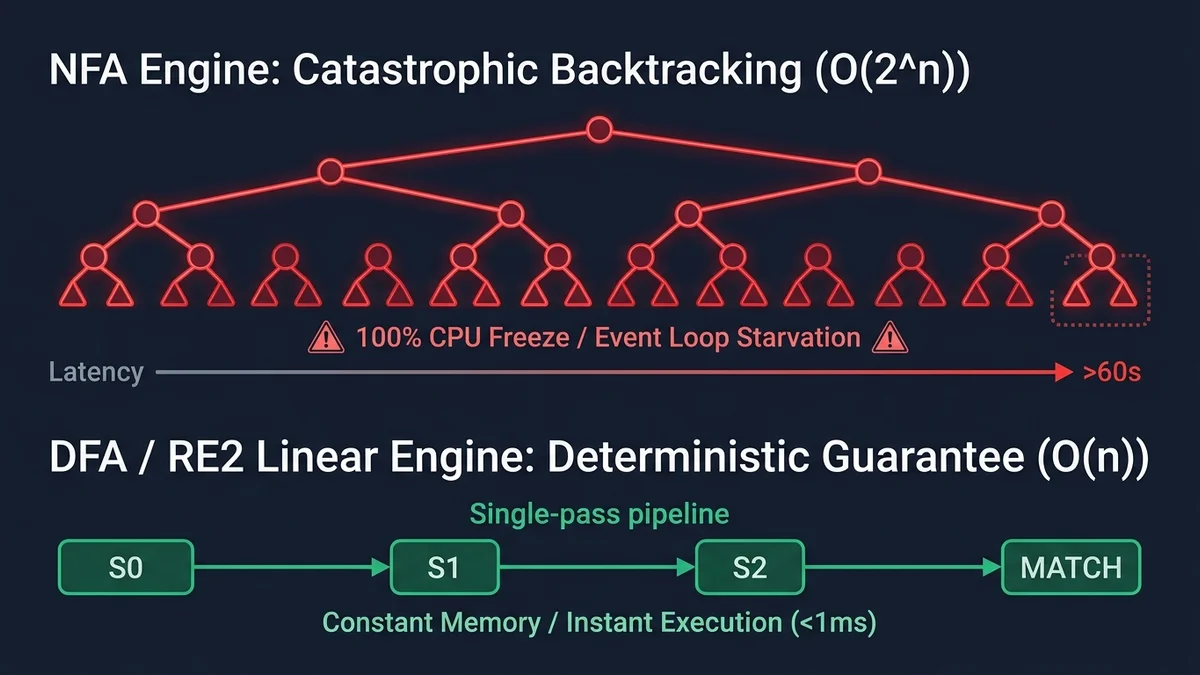
1. Anatomy of a 40-Character Event-Loop Freeze
Consider a deceptively simple regex meant to validate an alphanumeric slug or username: /^([a-zA-Z0-9]+)+$/. Test it against "valid_user_2026" or "aaaaaaaaaaaaaaaaaaaaaaaaaaaaaa" and JavaScript returns true in 0.01 milliseconds. Now pass a 35-character failing string—34 'a' characters followed by a single trailing '!': "aaaaaaaaaaaaaaaaaaaaaaaaaaaaaaaaaa!".
When the engine reaches the '!' at the end, the overall match fails. Rather than giving up immediately, a backtracking NFA engine tries every possible way to partition those 34 'a' characters between the inner + and the outer +: (34), (33, 1), (32, 2), (32, 1, 1), (31, 3), and so on. There are 2^33 (over 8.5 billion) distinct ways to split 34 identical characters! Each additional character doubles execution time. At 30 characters it takes ~150 ms; at 35 characters it takes ~5 seconds; at 40 characters a single RegExp.test() call locks up the Node.js event loop for nearly three minutes.
2. NFA Backtracking Engines vs. DFA Linear-Time Engines
Not all regular expression engines share this vulnerability. The divide comes down to classical automata theory—specifically whether an engine simulates a backtracking Non-deterministic Finite Automaton (NFA) or uses Ken Thompson's lockstep NFA / Deterministic Finite Automaton (DFA) algorithm.
Backtracking NFA engines (JavaScript's V8 Irregexp, Python's stdlib re, PHP/PCRE, Ruby, and Java's java.util.regex) perform a depth-first search through every branching choice. They do this to support non-regular features like backreferences (\1) and arbitrary lookaround assertions ((?=...), (?<=...)), which mathematically cannot be compiled into a pure DFA. The price of that expressiveness is worst-case exponential `O(2^n)` or polynomial `O(n^k)` time complexity.
Linear-time engines—including Google RE2, Go's `regexp`, Rust's `regex` crate, and .NET 7+'s `RegexOptions.NonBacktracking`—deliberately omit backreferences and lookarounds so they can track all active automaton states simultaneously in a single left-to-right scan of the input string. Regardless of how adversarial the input is, matching takes strictly **O(n * m) time** proportional to input length times pattern size.
| Runtime / Library | Engine Type | Worst-Case Complexity | Backreferences / Lookaround | ReDoS Protection Mechanism |
|---|---|---|---|---|
JavaScript / Node.js (RegExp) | Backtracking NFA (V8 Irregexp) | Exponential O(2^n) | Yes (both supported) | None natively (V8 linear experimental flag only) |
Node.js re2 (C++ addon) | Thompson NFA / Lazy DFA | Linear O(n) | No (intentionally omitted) | Guaranteed linear-time execution |
Python stdlib re | Backtracking NFA | Exponential O(2^n) | Yes (both supported) | None natively (use google-re2 package) |
Go stdlib regexp | Thompson NFA / DFA (RE2) | Linear O(n) | No | Guaranteed linear-time by specification |
Rust regex crate | Hybrid DFA / PikeVM | Linear O(n) | No | Guaranteed linear-time (memory-bounded) |
.NET (Regex) | Backtracking NFA or NonBacktracking | O(2^n) or Linear O(n) | Only in default mode | RegexOptions.NonBacktracking + matchTimeout |
| PCRE2 / PHP | Backtracking NFA + JIT | Exponential O(2^n) | Yes + Atomic Groups | pcre.backtrack_limit cap + possessive quantifiers |
3. The Four Deadly ReDoS Anti-Patterns
Whenever you audit code or inspect JSON validation schemas—for instance, when reviewing structured payloads alongside our JSON Formatter & Diff Viewer—train your eye to spot these four structural signatures immediately:
- Nested quantifiers (Exponential `O(2^n)`): A repeated group containing an inner repeated token, such as
(a+)+,([a-zA-Z0-9_]+)*, or(\w+\s?)+. Whenever a single character can be matched by either continuing the inner repetition or starting a new outer iteration, failure triggers exponential backtracking. - Overlapping alternations inside a quantifier (Exponential `O(2^n)`): Patterns like
(a|aa)+,(\s|\S)+, or([a-z]+|[a-z0-9]+)+where two branches of an|alternation can match the exact same character. Because both branches compete for identical characters, every ambiguous position doubles the search tree. - Adjacent overlapping greedy wildcards (Polynomial `O(n^2)` to `O(n^3)`): Patterns such as
.*foo.*bar.*bazor\s+.*\s+without strict negation boundaries. Even without exponential blowup, a cubicO(n^3)polynomial regex on a 50 KB input string executes 1.25 × 10^14 steps—still plenty to freeze an API server for minutes. - Unbounded whitespace or optional delimiters in unanchored parsers: Patterns like
^\s*([\s\S]*?)\s*$or loose HTML/URL extractors (https?:\/\/.*\.(com|org)) running over large multi-kilobyte text documents without anchors or negated character classes.
4. Refactoring Vulnerable Patterns into Linear-Time Expressions
The golden rule of ReDoS-safe regex authoring is mutual exclusivity: at every character position in the input string, there must be at most one valid path forward through the regex. Replace vague wildcards (.*, [\w.-]+) with explicit negated character classes ([^\s@]+, [^"\\]*) and enforce strict delimiters between repeated groups so the inner and outer quantifiers can never match the same character.
// VULNERABLE (Exponential O(2^n)): nested quantifier on domain labels
// Input: "a@aaaaaaaaaaaaaaaaaaaaaaaaaaaaaaa!" freezes Node.js
const unsafeEmail = /^([a-zA-Z0-9._-]+)@([a-zA-Z0-9-]+\.?)+$/;

// SAFE (Linear O(n)): explicit mandatory '.' separator between labels
// Every label is mutually exclusive with '.', eliminating ambiguity
const safeEmail =
  /^[a-zA-Z0-9.!#$%&'*+/=?^_`{|}~-]{1,64}@[a-zA-Z0-9-]+(?:\.[a-zA-Z0-9-]+)+$/;

// VULNERABLE (Polynomial O(n^2)): overlapping whitespace around greedy .*
const unsafeTrim = /^\s*(.*?)\s*$/;

// SAFE (Linear O(n)): use native string methods or non-overlapping boundaries
const safeTrim = (input: string) => input.trim();

// VULNERABLE (Polynomial O(n^2)): greedy wildcard inside Markdown link text
const unsafeMarkdownLink = /\[(.*)\]\((.*)\)/;

// SAFE (Linear O(n)): negated character classes prevent cross-delimiter backtracking
const safeMarkdownLink = /\[([^\]\r\n]{1,256})\]\(([^)\s]{1,2048})\)/;Notice how bounded quantifiers ({1,64}, {1,256}) and mandatory non-overlapping delimiters ((?:\.[a-zA-Z0-9-]+)+) eliminate ambiguity completely. Better still: whenever a dedicated parser already exists—such as new URL(input) for URLs, String.prototype.trim() for whitespace, or a proper AST parser for HTML and Markdown—delete the regular expression altogether.
5. Defense-in-Depth: Input Caps, Node.js `re2`, and CI Auditing
Even disciplined teams eventually import a third-party utility or accept user-defined filter patterns in search dashboards. Build three structural guardrails around every regex touching external input:
import RE2 from "re2";

// Compile untrusted or complex patterns with RE2 (guaranteed O(n) linear time)
const safeLogFilter = new RE2("^\\[(INFO|WARN|ERROR)\\]\\s+[^\\r\\n]{1,512}$");

export function validateUserField(raw: unknown, maxLen = 254): boolean {
  if (typeof raw !== "string") return false;

  // Guardrail 1: Enforce hard byte/character length cap BEFORE running any regex
  if (raw.length === 0 || raw.length > maxLen) return false;

  // Guardrail 2: Execute via linear-time RE2 automaton (never blocks event loop)
  return safeLogFilter.test(raw);
}6. Production ReDoS Security & Performance Checklist
Apply these six controls across your backend services, edge workers, and validation schemas:
- Enforce explicit maximum input length caps (
maxLengthin Zod/JSON Schema/API validators) before invoking any regular expression on user-controlled strings. - Replace complex regex parsers for URLs, dates, JSON, HTML, and CSV with native standards-compliant parsers (
new URL(),JSON.parse(), DOMPurify). - Eliminate nested quantifiers, overlapping alternations, and adjacent greedy wildcards by enforcing mutually exclusive negated character classes.
- Use the
re2C++ binding in Node.js (orgoogle-re2in Python) whenever executing complex patterns or user-supplied search regexes against untrusted payloads. - Enable
eslint-plugin-regexp(no-super-linear-backtracking) and runrecheckstatic ReDoS verification in CI on every pull request. - Never execute unvetted regexes inside Cloudflare Workers, Next.js Middleware, or API gateways where a single event-loop stall cascades into global 502 timeouts.
Frequently asked questions
true in microseconds. Catastrophic backtracking erupts specifically when a long prefix matches ambiguously but a single mismatching character appears near the end. Forced to prove that *no* alternative partition can succeed, the engine systematically unwinds and tests every exponential permutation before finally returning false.setTimeout() or AbortController cannot interrupt an actively executing RegExp.test() call once it enters a backtracking loop. While you could offload regex matching to a Worker Thread and call worker.terminate() after a timeout, that adds significant serialization overhead and latency. Switching to linear-time patterns or using the re2 native addon is far cleaner and faster.--enable-experimental-regexp-engine V8 flag (using the /l flag on regex literals) that executes supported expressions in guaranteed linear time. However, it remains non-standard across browsers and requires opting in per expression or via a runtime flag that breaks backreferences. For portable, production-ready Node.js backends today, refactoring patterns to be unambiguous and using the re2 package remains the industry standard.O(n^2) and O(n^3) regexes are absolutely dangerous on real-world inputs. While an exponential pattern freezes a server with 40 characters, a quadratic O(n^2) regex running against a 100 KB Markdown document, HTTP header, or JSON payload performs 10 billion matching steps—freezing a Node.js event loop for several seconds per request and allowing a handful of concurrent requests to saturate all CPU cores.local@domain.tld structure with mutually exclusive character classes, and verify actual deliverability via an asynchronous confirmation link rather than brittle regex gymnastics.Sources

Written by
Wazir Ahmed
CTO, DEESU and CEO, D.TEN
Dr. Wazir Ahmed is the CTO of DEESU and leads D.TEN, its training and education division. A training manager, educational psychologist and researcher with a Ph.D. in educational psychology, he oversees learning systems, technology architecture, and training design.
More from WazirFree tools for this topic
Need help with this?