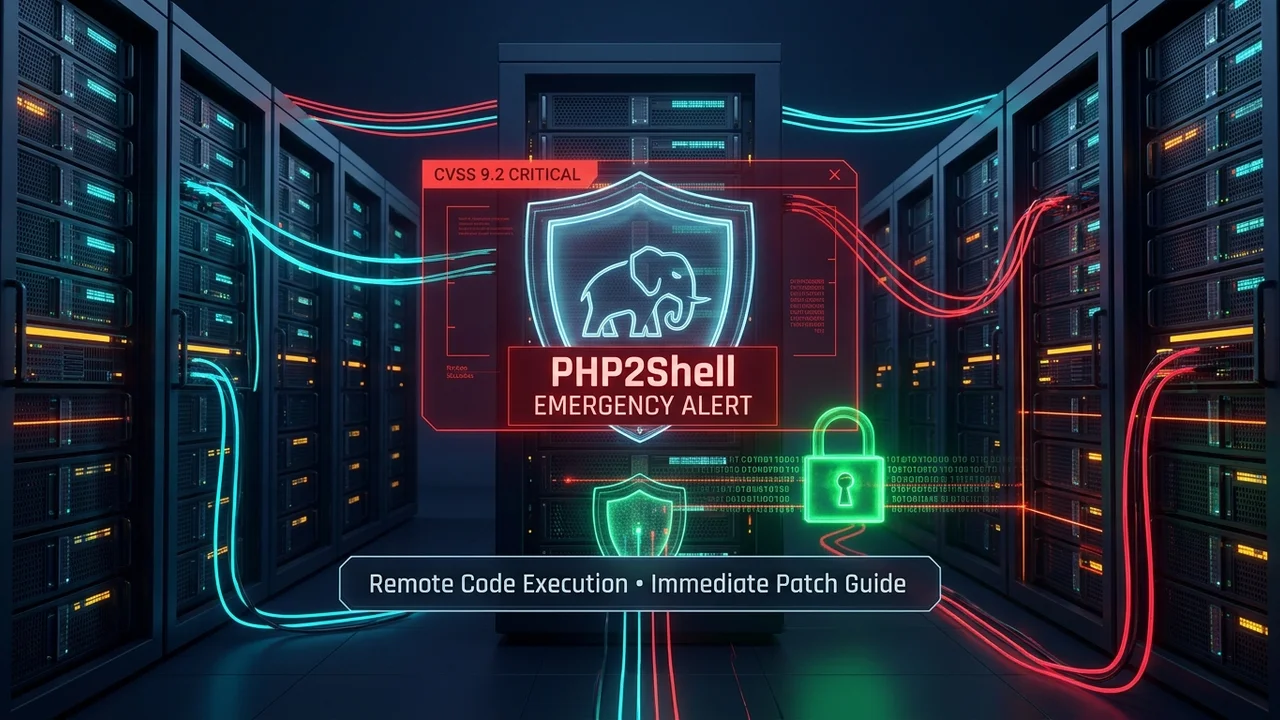
The software engineering industry in 2026 has crossed a definitive threshold: AI coding assistants, autonomous agentic IDEs, and prompt-driven scaffolding tools are no longer experimental novelties. They are embedded into the daily workflows of millions of engineers. Recent industry surveys reveal that more than 72% of modern software developers rely on generative AI tools to draft functions, generate database queries, and scaffold full-stack microservices.
However, this massive explosion in developer productivity has brought an equally massive security crisis. Large Language Models (LLMs) are trained on massive public repositories containing millions of lines of outdated, unpatched, and historically vulnerable code. Because an LLM optimizes for mathematical token probability rather than cryptographic safety or defensive programming, it frequently outputs code that looks syntactically pristine while containing catastrophic security vulnerabilities.
In this comprehensive engineering guide, we break down the most dangerous security vulnerabilities unique to AI-generated code, examine real-world attack vectors such as Package Hallucination (Slopsquatting) and Silent IDOR Flaws, and provide an end-to-end automated verification pipeline to protect enterprise production systems.
1. The Top Security Flaws in AI-Generated Code
Security researchers have benchmarked thousands of AI-generated software functions across Python, TypeScript, Go, and Java. The findings are sobering: while AI models rarely make syntax errors, they systematically commit deep logical and authorization blunders.
| Vulnerability Type | How the LLM Generates It | Severity & Impact | Defensive Remediation |
|---|---|---|---|
| Package Hallucination (Slopsquatting) | AI invents plausible package names that attackers preemptively register on public registries. | Critical (RCE) | Private registry proxies with strict package allowlists and hash enforcement. |
| Broken Tenant Isolation (IDOR) | AI queries database by record ID without appending the authenticated user or tenant ID. | High (Data Leak) | Row-Level Security (RLS) in PostgreSQL and mandatory tenant scoping wrappers. |
| Insecure Direct Object Deserialization | AI uses native pickle or JSON.parse on untrusted inputs without schema validation. | Critical (RCE) | Strict Zod / Pydantic contract validation before object parsing. |
| Client-Side Secret Exposure | AI injects sensitive API keys into React Server Component client boundaries or Next.js public envs. | High (Credential Theft) | Build-time secret scanning with GitGuardian and zero-trust credential vaults. |
| Weak Cryptographic Defaults | AI uses MD5, SHA-1, or math/random instead of cryptographically secure random number generators. | Medium (Predictable Tokens) | Linter rules enforcing crypto.getRandomValues() and Argon2id password hashing. |
2. The 'Package Hallucination' Exploit: Anatomy of Slopsquatting
Perhaps the most alarming vulnerability unique to generative AI is Package Hallucination, commonly termed *Slopsquatting*. When a developer prompts an AI assistant: *'Write a Node.js utility to extract OpenGraph meta tags from incoming HTML buffers'*, the LLM frequently invents a non-existent package name like @company-utils/html-og-extract or react-native-secure-jwt-store.
Because the code snippet appears fully functional and comes with clean usage examples, busy developers instinctively run npm install @company-utils/html-og-extract or pip install py-secure-token-vault. If the package does not exist, malicious threat actors running automated LLM-probing bots register that exact package on npm or PyPI within minutes, embedding an obfuscated preinstall bash script that exfiltrates local .env files, AWS credentials, and SSH keys.
In 2025 and 2026, security researchers demonstrated that over 20% of hallucinated Python and Node.js package recommendations could be successfully weaponized by attackers using this exact mechanism.
3. Silent Authorization Flaws (IDOR in Server Actions)
When human engineers write authentication logic, they naturally consider permissions. However, when an LLM writes a Next.js Server Action or Express endpoint to update a user's billing address, it invariably generates code that looks like this:
// VULNERABLE: Typical AI-Generated Server Action
"use server";
import { db } from "@/lib/db";

export async function updateShippingAddress(formData: FormData) {
  const orderId = formData.get("orderId") as string;
  const newAddress = formData.get("address") as string;

  // The AI assumes orderId is sufficient and updates the record directly!
  // Any attacker can pass any other user's orderId and hijack shipments!
  await db.order.update({
    where: { id: orderId },
    data: { shippingAddress: newAddress },
  });

  return { success: true };
}
Notice the fatal flaw: the AI forgot to verify whether the currently authenticated user actually *owns* orderId! Any authenticated customer can submit another customer's orderId and hijack their deliveries or access their private invoices. Because this flaw is logical rather than syntactical, traditional static linters (like ESLint) pass with zero warnings.
4. Building an Automated Verification Pipeline for AI Code
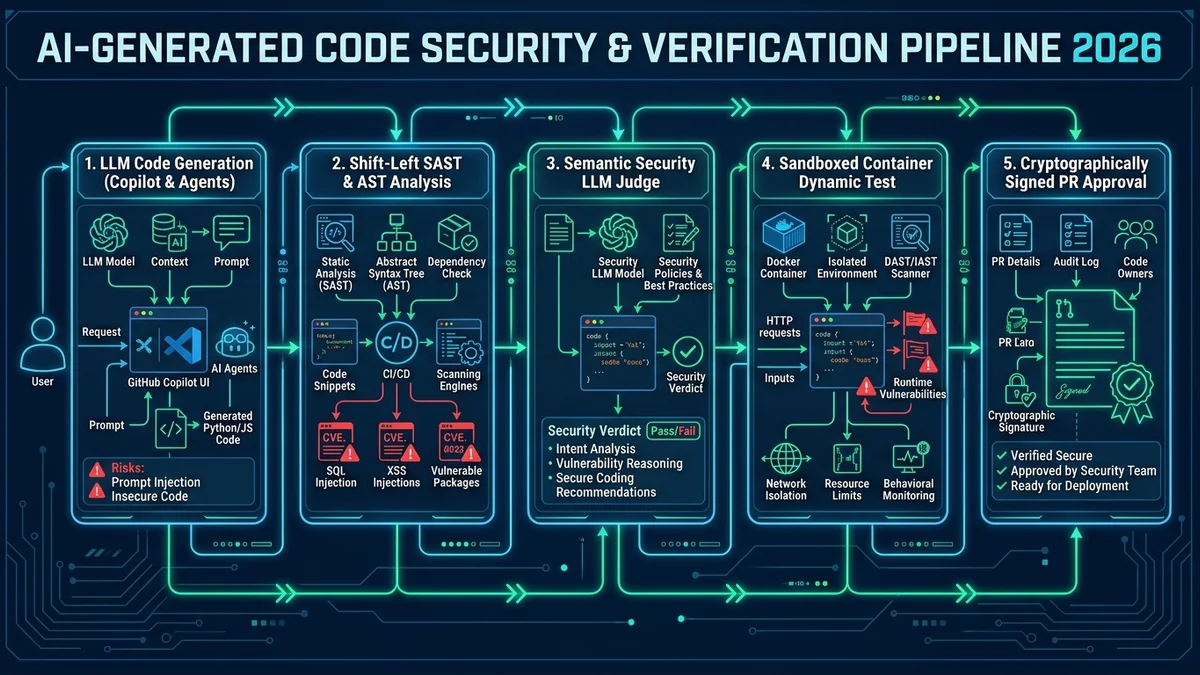
To safely harness the speed of AI coding without compromising production security, engineering teams must establish an automated, 4-stage shift-left verification pipeline:
- Stage 1: AST Semantic Rules via Semgrep ($0): Run open-source Semgrep rules in your local pre-commit hooks and GitHub Actions. Define custom AST rules that flag database mutations lacking tenant ID constraints, or disallow direct
JSON.parseon external webhook bodies. - Stage 2: Strict Lockfile & Registry Verification: Enforce
npm install --ignore-scriptsin CI/CD environments. Use enterprise npm proxies (like Verdaccio or AWS CodeArtifact) that block newly registered packages less than 14 days old, completely neutralizing slopsquatting attacks. - Stage 3: Dual-LLM Adversarial Code Review: Never let the same model that wrote the code review it. Deploy an independent 'Security Critic' model (e.g., Claude 3.5 Sonnet or DeepSeek-R1) prompted strictly as a hostile black-hat penetration tester to audit PR diffs for OWASP vulnerabilities.
- Stage 4: Ephemeral Sandboxed Runtime Testing: Run automated integration tests inside isolated, non-root containers with outbound network access restricted via firewall rules (such as our Docker Run to Compose Converter).
5. Production-Ready Semgrep Security Rule Example
Here is a battle-tested Semgrep rule that automatically catches AI-generated database queries that mutate records without checking authenticated tenant ownership:
rules:
  - id: ai-unscoped-db-update
    languages: [typescript, javascript]
    message: "Detected database update without tenant/user ownership verification. Potential IDOR vulnerability!"
    severity: ERROR
    patterns:
      - pattern: db.$MODEL.update({ where: { id: $ID }, ... })
      - pattern-not: db.$MODEL.update({ where: { id: $ID, userId: $USER }, ... })
      - pattern-not: db.$MODEL.update({ where: { id: $ID, tenantId: $TENANT }, ... })
6. The 2026 Developer Checklist for AI-Assisted Engineering
Before approving or merging any pull request containing AI-generated logic, ensure every engineer adheres to this 5-point verification protocol:
- Verify every external library on npmjs.com or pypi.org before installing; check creation date, download volume, and maintainer reputation.
- Confirm that all database mutations and read queries enforce explicit tenant ownership or rely on PostgreSQL Row-Level Security (RLS).
- Ensure all external inputs (URL params, headers, request bodies) pass through strict Zod schemas before reaching business logic.
- Inspect React components for unintended leakage of private environment variables (like non-PUBLIC secret keys).
- Execute automated test suites in a rootless container sandbox with zero ambient cloud credentials.
Frequently asked questions
Sources

Written by
Wazir Ahmed
CTO, DEESU and CEO, D.TEN
Dr. Wazir Ahmed is the CTO of DEESU and leads D.TEN, its training and education division. A training manager, educational psychologist and researcher with a Ph.D. in educational psychology, he oversees learning systems, technology architecture, and training design.
More from WazirNeed help with this?