
When software engineering teams transition from stateful monolithic sessions to distributed microservices, JSON Web Tokens (RFC 7519) are almost universally adopted as the default identity currency. The promise is seductive: completely stateless authentication where services independently verify user claims without hitting a central database.
Yet in 2026, JSON Web Tokens remain one of the most prolific sources of high-severity authentication bypasses, broken object-level authorization (BOLA), and privilege escalation vulnerabilities across cloud APIs and mobile backends. According to recent application security audits, over 38% of custom JWT verification implementations contain critical configuration flaws that completely invalidate their cryptographic guarantees.
The fundamental danger of JWT is not the math behind RSA or HMAC SHA-256; it is the flexibility of the specification itself. By embedding the verification parameters (such as the signing algorithm) directly inside the untrusted client-supplied header, the protocol trusts the caller to tell the server how to verify them—unless the backend is strictly hardened.
In this engineering guide, we dissect the mechanics of modern JWT vulnerabilities—including Algorithm Confusion, the persistent 'alg: none' bypass, and replay attacks—and provide production-tested TypeScript architecture patterns to guarantee zero-trust token verification.
1. The Anatomy of a Modern JWT: Encoding vs Encryption
A standard JSON Web Token consists of three distinct URL-safe base64-encoded segments joined by periods: Header.Payload.Signature.
- Header: Contains metadata specifying the cryptographic algorithm (
alg) and token type (typ). Example:{"alg": "HS256", "typ": "JWT"}. - Payload: Contains identity claims such as subject (
sub), issuance timestamp (iat), expiration (exp), and application roles. Example:{"sub": "usr_882", "role": "admin"}. - Signature: A cryptographic hash generated by taking
HMACSHA256(base64Url(header) + "." + base64Url(payload), secret)or an RSA/ECDSA private key signature.
2. The Algorithm Confusion Attack (HS256 vs RS256)
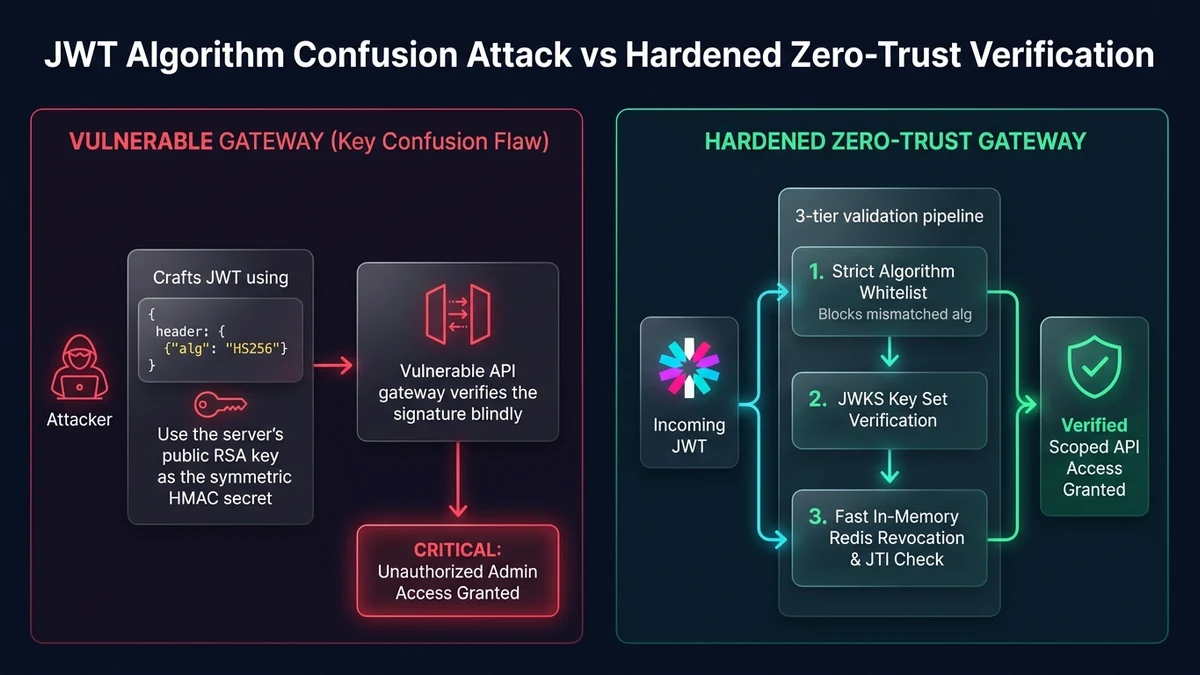
The Algorithm Confusion (or Key Confusion) attack remains one of the most elegant and catastrophic flaws in web security. It exploits the mathematical asymmetry between public-key cryptography (RS256) and symmetric-key cryptography (HS256).
How the Exploit Operates
Consider a typical modern authentication architecture: an identity server (like Auth0, Keycloak, or AWS Cognito) signs tokens using an asymmetric RS256 private key. Microservices verify these tokens using the identity provider's publicly available RSA Public Key (often retrieved via a .well-known/jwks.json endpoint).
Here is how a malicious actor exploits a vulnerable microservice:
- Attacker retrieves the public key: The attacker fetches the server's public key (e.g.
public.pem), which is deliberately public and unencrypted. - Attacker crafts a rogue token: The attacker creates a payload giving themselves administrative privileges (
{"sub": "attacker", "role": "superadmin"}). - Attacker modifies the header: The attacker alters the token header to specify a symmetric algorithm:
{"alg": "HS256", "typ": "JWT"}. - Attacker signs using the public key: Because HS256 is a symmetric algorithm, it uses a single shared secret. The attacker hashes their forged payload using the server's RSA Public Key string as the HMAC secret!
- Vulnerable server validates: When the vulnerable microservice parses the token, it reads
alg: HS256. It passes its configured key variable (which holds the public key) into the HMAC verifier. The math matches perfectly: HMAC(public_key) == signature. The attacker is granted full administrative access!
3. The Zombie Flaw: The 'alg: none' Vulnerability
The original RFC 7519 specification allowed an algorithm parameter named none, intended for debug environments where cryptographic integrity is verified at a different protocol layer. In an unsecured token, the signature segment is completely empty: eyJhbGciOiJub25lIiwidHlwIjoiSldUIn0.eyJzdWIiOiIxMjMifQ.
While first discovered over a decade ago (CVE-2015-9235), this vulnerability repeatedly re-emerges in 2026 applications due to subtle parsing regressions:
- Case-Sensitivity Bypasses: Some custom parsers check
if (header.alg === 'none') reject(), but acceptNone,NONE, ornOnE. - Dual-Mode Verification Libraries: Libraries that feature separate
decode()andverify()helper functions. Developers mistakenly calldecode()to read user claims before verifying the cryptographic signature. - Internal Service Mesh Trust: APIs that strip JWT signatures at the edge proxy and forward unsigned tokens to internal microservices, leaving backend endpoints vulnerable to internal spoofing.
4. The Expiry & Revocation Paradox in Microservices
By definition, a stateless JWT cannot be revoked before its expiration timestamp (exp) without introducing state. If an employee is fired, an account is breached, or a laptop is stolen, any valid JWT in the wild continues to grant access until the token expires.
To solve this without sacrificing microservice throughput, production systems implement a Hybrid Token Lifecycle:
| Token Type | Recommended Lifetime | Storage Medium | Revocation Mechanism |
|---|---|---|---|
| Access Token | 5 to 15 minutes | Memory / Authorization Header | Short TTL (expires naturally) |
| Refresh Token | 7 to 30 days | HttpOnly, SameSite=Strict Cookie | Database / Redis Token Family Rotation |
| Revocation Denylist | Matches Access Token TTL | In-Memory Redis Cluster | Keyed by unique JWT ID ('jti') |
5. Production Implementation: Hardened TypeScript JWT Verification
Below is a battle-tested, zero-trust JWT verification implementation using the standard, audited jose library in Node.js/TypeScript. It strictly eliminates algorithm confusion, enforces expiration, and validates cryptographic issuers:
import { jwtVerify, createRemoteJWKSet } from "jose";

// Hardened production configuration
const AUTH_ISSUER = "https://auth.deesu.org/";
const AUTH_AUDIENCE = "https://api.deesu.org";
const EXPECTED_ALGORITHM = "RS256";

// Cache remote JWKS public keys securely
const JWKS = createRemoteJWKSet(
  new URL("https://auth.deesu.org/.well-known/jwks.json"),
  {
    cacheMaxAge: 600000, // 10 minutes cache
    cooldownDuration: 30000, // Prevent JWKS endpoint hammering
  }
);

export interface VerifiedAuthPayload {
  userId: string;
  role: string;
  jti: string;
}

export async function verifyProductionJwt(token: string): Promise<VerifiedAuthPayload> {
  try {
    // CRITICAL: Explicitly specify algorithms: [EXPECTED_ALGORITHM]
    // This immediately neutralizes HS256 algorithm confusion and 'alg: none' attacks!
    const { payload, protectedHeader } = await jwtVerify(token, JWKS, {
      issuer: AUTH_ISSUER,
      audience: AUTH_AUDIENCE,
      algorithms: [EXPECTED_ALGORITHM], // Strict algorithm whitelist
      clockTolerance: "15s", // Prevent small NTP clock drift failures
    });

    // Verify required claims exist
    if (!payload.sub || typeof payload.sub !== "string") {
      throw new Error("Missing required subject claim ('sub')");
    }
    if (!payload.jti || typeof payload.jti !== "string") {
      throw new Error("Missing unique token identifier ('jti')");
    }

    // Optional: Check Redis denylist for revoked JTI tokens
    const isRevoked = await checkRedisRevocationList(payload.jti);
    if (isRevoked) {
      throw new Error("Token has been revoked by user logout or security policy");
    }

    return {
      userId: payload.sub,
      role: (payload.role as string) || "user",
      jti: payload.jti,
    };
  } catch (error: any) {
    console.error(`[AUTH_FAIL] JWT verification failed: ${error.message}`);
    throw new Error("Unauthorized: Invalid, expired, or forged authentication token");
  }
}

async function checkRedisRevocationList(jti: string): Promise<boolean> {
  // Query Redis in-memory cache: EXISTS denylist:${jti}
  return false;
}6. The 2026 JWT Hardening Checklist
- Never trust the incoming 'alg' header: explicitly enforce an algorithm whitelist (e.g. ['RS256'] or ['ES256']).
- Ban 'alg: none' explicitly in all verification layers, gateways, and reverse proxies.
- Always set a strict expiration claim ('exp') with a lifetime of 15 minutes or less for access tokens.
- Generate a cryptographically random 'jti' claim for every token to support real-time revocation via Redis.
- Never store passwords, internal API keys, or raw personal data inside the unencrypted token payload.
- Store refresh tokens exclusively in Secure, HttpOnly, SameSite=Strict cookies on web, or encrypted keychains on mobile.
Frequently asked questions
Sources

Written by
Hamza Fazal
Founder, DEESU
Muhammad Hamza Fazal is the Founder of DEESU. An Android and full-stack web developer and digital marketer based in Islamabad, he founded DEESU in May 2022 and leads its engineering operations, product strategy, and client software delivery.
More from HamzaFree tools for this topic
Need help with this?