Every engineering team building with AI in 2026 goes through the exact same three phases. In Phase 1, you wire up the smartest model available—usually Claude 3.5 Sonnet or GPT-4o—and your users love it because the answers are brilliant. In Phase 2, you launch to real production traffic, add multi-step AI agent workflows, and watch your monthly API bill explode from $400 to $14,000.
Phase 3 is where reality hits: your CFO asks why your software margins look like a catering business, and your users complain that waiting 4 seconds for a simple 'Yes/No' classification feels unacceptably slow. You realize you have been using a $300,000 industrial crane to hammer in a thumbtack.
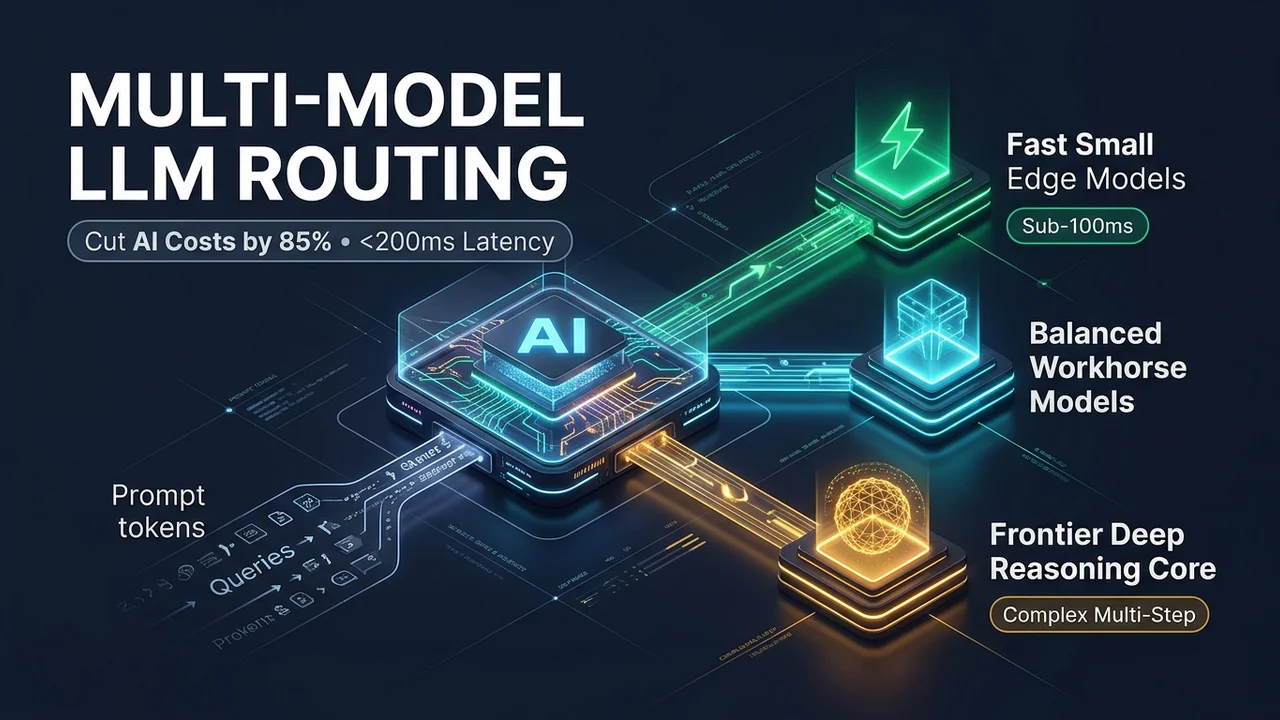
The solution that high-scale AI startups and enterprise engineering teams use in 2026 is Multi-Model LLM Routing. Instead of treating an LLM like a monolithic black box, an intelligent router sits between your application and your AI providers. It evaluates incoming prompts in microseconds and routes each task to the fastest, cheapest model capable of solving it with 100% accuracy.
Teams that implement multi-model routing typically see an 80% to 85% reduction in token spend while dropping average response latency under 300 milliseconds. In this guide, we break down how multi-model routing works, explore the architectural patterns used by production systems, examine the hidden traps that catch naive implementations, and walk through a complete, copy-pasteable TypeScript implementation.
The One-Size-Fits-All Model Anti-Pattern
To understand why routing is so effective, look at how modern AI applications actually spend their tokens. In an agentic workflow or customer-facing SaaS, only about 15% to 20% of requests require deep, multi-step logical reasoning. The remaining 80% to 85% consist of simple, repetitive tasks:
- Intent classification: Deciding whether a user is asking for billing support, technical help, or product pricing.
- Information extraction: Pulling a date, order ID, or tracking number out of an email body.
- Format transformation: Converting raw text into a clean JSON schema.
- Guardrail & toxicity screening: Verifying that user input does not contain prompt injections or abusive language.
- Tool parameter extraction: Extracting search query parameters to pass to a database or MCP server.
Frontier models charge premium rates for their advanced reasoning capabilities ($3.00 to $15.00+ per million tokens). Paying frontier prices to check if a user typed 'cancel my subscription' is financial madness. A modern Small Language Model (SLM) running at $0.05 to $0.15 per million tokens performs that exact classification with identical 99.9% accuracy, in a fraction of the time.
The 3-Tier Model Architecture for 2026
Production architectures group models into three distinct operational tiers based on speed, cost, and cognitive reasoning depth:
| Tier | Representative Models | Avg Cost / 1M Tokens | TTFT (Latency) | Best Suited For |
|---|---|---|---|---|
| Tier 1: Edge & Tiny Models | Llama 3.2 1B/3B, Gemini 1.5 Flash-8B, Gemma 2B | $0.05 – $0.15 | 60ms – 150ms | Intent classification, sentiment analysis, simple routing tags, guardrails, regex-like data extraction. |
| Tier 2: Workhorse Engines | GPT-4o-mini, Claude 3.5 Haiku, Mistral Small | $0.15 – $0.60 | 150ms – 350ms | Summarization, multi-turn Q&A, drafting emails, document translation, standard JSON tool calling. |
| Tier 3: Frontier Reasoning | Claude 3.5 Sonnet, GPT-4o, OpenAI o1 | $3.00 – $15.00+ | 800ms – 3,000ms+ | Complex multi-file refactoring, legal/financial contract analysis, math proofs, deep agentic planning. |
The goal of your router is simple: always assign a request to the lowest tier capable of satisfying the quality criteria.
How Intelligent Routing Works: 3 Production Patterns
There are three primary technical approaches used to build LLM routers in production, ranging from deterministic rules to machine-learning classifiers:
1. Rule-Based & Structural Routing (Fastest & Simplest)
In this pattern, the router examines deterministic properties of the incoming request before making any network call. If the request matches specific known parameters (e.g., input token length < 200 tokens, strict JSON extraction schema, or explicit task tags like 'summarize_title'), it immediately dispatches to Tier 1.
This approach adds virtually zero latency (<1 millisecond) and requires no external dependencies. It solves roughly 60% of all routing needs in typical web and mobile apps.
2. Semantic & Embedding-Based Routing (Semantic Clustering)
For ambiguous natural language prompts where rules fail, the router generates a small vector embedding of the user's prompt (using a tiny model or local bi-encoder like BGE-micro) and calculates cosine similarity against pre-clustered intent categories in memory.
For example, prompts matching clusters for 'creative brainstorming' or 'casual chat' route to Tier 2, while prompts matching 'architectural design' or 'code review' route directly to Tier 3. Open-source libraries like LMSYS RouteLLM use preference data and matrix factorization to score prompt difficulty on the fly.
3. Confidence-Based Escalation (Self-Healing Fallbacks)
What happens if a cheap Tier 1 model produces a bad answer or fails to format the requested JSON schema? In a naive system, your app crashes. In a production router, you use Confidence Escalation:
- Speculative Execution: Dispatch the prompt to the Tier 1 or Tier 2 model first.
- Strict Schema Validation: Pass the output through a strict validator (like a Zod schema in TypeScript or Pydantic in Python).
- Escalate on Failure: If validation fails, or if model logprobs indicate low confidence, silently re-dispatch the exact same prompt to the Tier 3 frontier model.
Because Tier 1 models run in under 150ms and cost almost nothing, 'gambling' on the cheap model first succeeds 92% of the time. You save 85% on 92 out of 100 requests, and the remaining 8 fail gracefully and succeed on the frontier model with only a minor latency increase.
The Dangerous Trap: The 'Cold-Cache Prefill' Penalty
While multi-model routing sounds straightforward on paper, there is one massive architectural trap that bankrupts unsuspecting engineering teams: KV Cache Invalidation (The Cold-Cache Penalty).
Modern LLM providers (Anthropic, OpenAI, DeepSeek, Google) offer massive prompt caching discounts—up to 75% to 90% off input tokens—when the prefix of your prompt (system prompts, tool definitions, chat history) matches a previous request held in memory in the provider's Key-Value (KV) cache.
To eliminate this problem, your router must implement Session Pinning:
- Independent Single-Shot Requests: Freely route per request based on complexity (e.g., API background workers, webhook processors, autonomous agent sub-tasks).
- Multi-Turn Conversational Threads: Route the *first* turn based on user intent, and then pin the session to that model family for the duration of the conversation. This keeps prompt cache hit rates above 80%, maximizing both latency and cost benefits.
Full Production Implementation: A TypeScript Router
Here is a clean, production-ready implementation of a multi-model router in TypeScript. It includes task classification, automated schema verification with Zod, and self-healing escalation from Tier 1 to Tier 3:
import { z } from "zod";

// 1. Define Model Tiers
export type ModelTier = "tier-1-fast" | "tier-2-workhorse" | "tier-3-frontier";

export interface ModelEndpoint {
  provider: "openai" | "anthropic" | "google";
  modelId: string;
  costPerMillionInput: number;
  costPerMillionOutput: number;
}

export const MODEL_REGISTRY: Record<ModelTier, ModelEndpoint> = {
  "tier-1-fast": {
    provider: "google",
    modelId: "gemini-1.5-flash-8b",
    costPerMillionInput: 0.075,
    costPerMillionOutput: 0.30,
  },
  "tier-2-workhorse": {
    provider: "openai",
    modelId: "gpt-4o-mini",
    costPerMillionInput: 0.15,
    costPerMillionOutput: 0.60,
  },
  "tier-3-frontier": {
    provider: "anthropic",
    modelId: "claude-3-5-sonnet-20241022",
    costPerMillionInput: 3.00,
    costPerMillionOutput: 15.00,
  },
};

// 2. Fast Deterministic Router (<1ms overhead)
export function classifyPromptComplexity(prompt: string, hasTools: boolean): ModelTier {
  const length = prompt.length;
  const lower = prompt.toLowerCase();

  // Simple classification / sentiment / short checks
  const isSimpleTask =
    length < 300 &&
    (lower.startsWith("classify") ||
     lower.startsWith("is this") ||
     lower.includes("yes or no") ||
     lower.startsWith("extract date"));

  if (isSimpleTask && !hasTools) {
    return "tier-1-fast";
  }

  // Deep reasoning triggers
  const requiresDeepReasoning =
    lower.includes("refactor") ||
    lower.includes("security audit") ||
    lower.includes("analyze architecture") ||
    lower.includes("solve equation") ||
    length > 3500;

  if (requiresDeepReasoning) {
    return "tier-3-frontier";
  }

  // Default balanced workhorse
  return "tier-2-workhorse";
}

// 3. Resilient Dispatcher with Self-Healing Fallback
export async function executeWithFallback<T>(
  prompt: string,
  systemPrompt: string,
  schema: z.ZodSchema<T>,
  options: { forceTier?: ModelTier; sessionId?: string } = {}
): Promise<{ data: T; tierUsed: ModelTier; escalated: boolean }> {
  // Determine starting tier
  const initialTier = options.forceTier || classifyPromptComplexity(prompt, false);

  try {
    // Attempt with initial recommended tier
    const rawResult = await callLlmProvider(MODEL_REGISTRY[initialTier], systemPrompt, prompt);
    const parsed = schema.parse(JSON.parse(rawResult));
    return { data: parsed, tierUsed: initialTier, escalated: false };
  } catch (err) {
    // If Tier 1 or Tier 2 fails schema validation, escalate to Tier 3
    if (initialTier !== "tier-3-frontier") {
      console.warn(`[Router] Tier '${initialTier}' failed schema validation. Escalating to frontier...`);
      const frontierResult = await callLlmProvider(MODEL_REGISTRY["tier-3-frontier"], systemPrompt, prompt);
      const parsed = schema.parse(JSON.parse(frontierResult));
      return { data: parsed, tierUsed: "tier-3-frontier", escalated: true };
    }
    throw err;
  }
}

// Dummy caller placeholder (use your standard SDK: OpenAI, Anthropic, or AI SDK)
async function callLlmProvider(endpoint: ModelEndpoint, system: string, user: string): Promise<string> {
  // Real implementation dispatches to your unified gateway or vendor client
  return "{}";
}Step Zero: Semantic Caching Before the Router
Even a $0.05 Tier 1 model is infinitely more expensive and slower than a cache hit. The highest-performing engineering teams place a Semantic Vector Cache (using Redis with RediSearch, Cloudflare KV, or PostgreSQL with pgvector) directly in front of their router.
When a user submits a prompt:
- Embedding Lookup: Convert the prompt into an embedding vector in ~15ms.
- Cosine Similarity Check: Check if an identical or near-identical prompt (similarity > 0.96) was already answered in the past 24 hours.
- Instant Cache Return: If matched, return the cached response immediately in 20ms at $0 cost, completely bypassing both the router and all LLMs.
- Cache Miss: If no match exists, pass the request to the router, record the response, and store it in the cache for future users.
In consumer applications and customer support portals, semantic caching routinely resolves 20% to 35% of all inbound traffic, providing an immediate performance boost that no model upgrade can match.
How to Roll Out Routing Without Breaking Production
If you have an existing application running entirely on a single frontier model, do not try to rewrite your entire architecture overnight. Follow this three-step phased migration:
- Step 1: Shadow Routing & Evaluation (Days 1–7): Add the router to your backend, but run it in shadow mode. Let your frontier model continue serving production traffic, while the router runs in the background and logs what tier it *would* have chosen. Compare outputs offline to verify accuracy.
- Step 2: Offload Non-Critical Background Jobs (Days 8–14): Move offline batch tasks (daily summaries, internal taggers, search indexers, notification drafts) to Tier 1 and Tier 2 models. Verify cost drops on your API dashboard.
- Step 3: Enable Self-Healing Real-Time Routing (Days 15+): Turn on the router for real-time user traffic with Zod schema validation and automatic Tier 3 escalation enabled. Monitor fallback rates (your escalation rate should ideally stay below 8%).
Summary: The Competitive Edge of Intelligent Architecture
In the early days of mobile and cloud computing, companies burned capital on oversized servers before discovering autoscaling and CDNs. The generative AI ecosystem has reached the exact same maturity point in 2026.
Relying on a single frontier model for every interaction is no longer a badge of quality—it is technical debt that balloons your burn rate and degrades your application's speed. By implementing a 3-tier model hierarchy, pinning multi-turn sessions to protect prompt caching, and backing your router with self-healing schema escalation, you turn AI from a cost center into a lean, scalable competitive advantage.
Frequently asked questions
Sources

Written by
Hamza Fazal
Founder, DEESU
Muhammad Hamza Fazal is the Founder of DEESU. An Android and full-stack web developer and digital marketer based in Islamabad, he founded DEESU in May 2022 and leads its engineering operations, product strategy, and client software delivery.
More from HamzaNeed help with this?