In early 2025, former OpenAI director of AI Andrej Karpathy coined the phrase 'vibe coding' to describe a radical shift in software creation: talking to an AI coding agent in plain English, hitting 'Accept', and letting intuition and automated iteration drive development without ever reading the generated syntax line-by-line.
For the first three weeks of a greenfield project, vibe coding feels like pure magic. Non-technical founders build full-stack web applications over a weekend. Junior engineers ship complex Stripe billing flows, OAuth integrations, and interactive dashboards in days rather than quarters. Social media is filled with viral demos of developers declaring that *'software engineering is dead and all you need is natural language prompts.'*
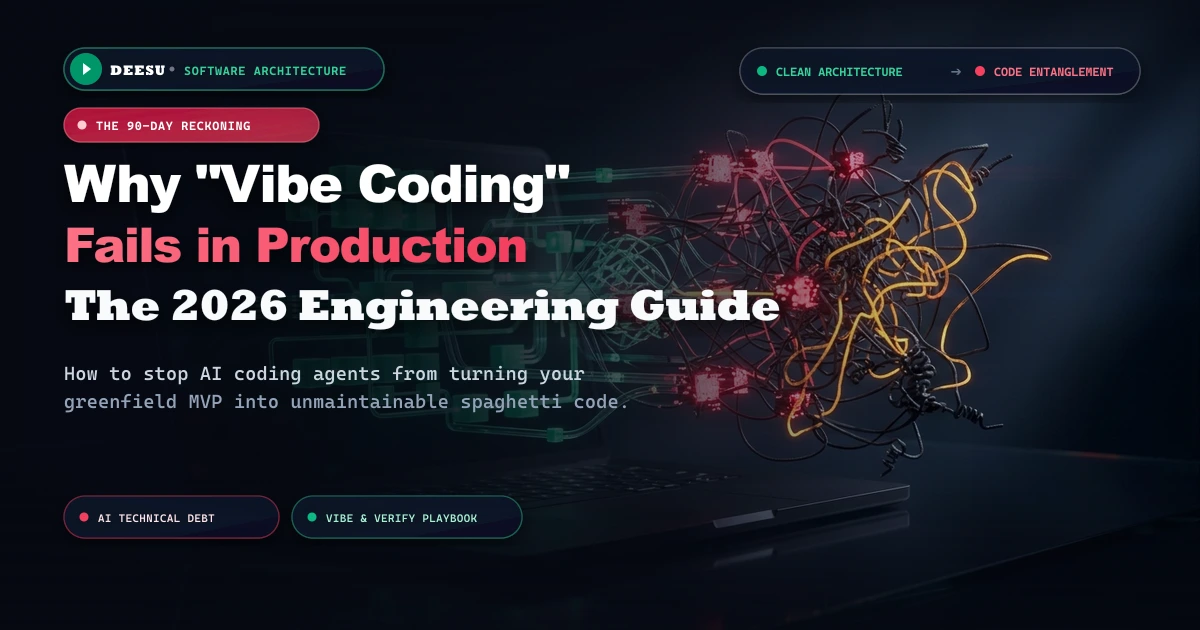
In late 2026, the tech industry is experiencing the inevitable hangover: the 90-Day Vibe Coding Reckoning. Engineering teams, startups, and agencies are drowning under codebases that were generated at breakneck speed but now cannot survive real-world production traffic, pass a security audit, or adapt to a simple database schema migration.
Writing code has become cheap, but architecture, reliability, and ownership remain intensely expensive. In this guide, we analyze why pure vibe coding breaks down at scale, examine the four fatal architectural traps of unguided AI code, and provide the battle-tested engineering playbook for directing AI agents with architectural rigor.
The Inverted Economics of Software Engineering in 2026
Historically, the primary bottleneck in software development was typing speed, syntax mastery, and boilerplate generation. Because writing code was time-consuming and expensive, developers were forced to think through architectural abstractions, interface boundaries, and data structures *before* writing hundreds of lines.
AI coding agents (Cursor, Claude Code, Windsurf, Copilot Workspace) eliminated the syntax bottleneck. Today, generating 5,000 lines of functional TypeScript or Python takes seconds. However, this has inverted the fundamental economics of software:
- Code Generation Cost: Dropped to near-zero ($0). An LLM can generate an entire CRUD service with a single prompt.
- Code Comprehension Cost: Skyrocketed. Reviewing 2,000 lines of dense, AI-generated code that lacks a human narrative or deliberate design intent takes twice as long as reviewing human-written code.
- Debugging Cost: Exponentially higher. When an unverified AI-generated async queue deadlocks under high production concurrency, the creator has no internal mental model of how the system was constructed.
The 4 Fatal Traps of Vibe-Coded Production Systems
Why do vibe-coded MVPs consistently hit an insurmountable brick wall around Day 90? Through code audits of dozens of AI-built startup codebases, senior architects consistently find the exact same four structural failures:
1. Rampant Logic Duplication (The Context Amnesia Problem)
LLMs solve the immediate prompt in front of them within a localized context window. When an engineer prompts: *'Add input validation to the checkout form'*, the agent rarely searches the broader repository for existing validation utilities. Instead, it hallucinates a new inline validation routine.
Within 90 days, a vibe-coded repository typically contains five different date-formatting libraries, four slightly incompatible JWT token parsers, and three disparate email validation regexes. When a security vulnerability or business logic change occurs, engineers patch two instances and miss the other three, creating critical production vulnerabilities.
2. The Black-Box Concurrency Trap
Modern AI agents excel at writing code that *looks* right for a single user in a local development environment. However, agents routinely fail to anticipate distributed edge cases: database race conditions, unindexed query scans, connection pool exhaustion, and memory leaks in long-running Node.js event loops.
A non-technical founder or junior developer can prompt an agent to build a seat-booking system. It works flawlessly on localhost. But when 200 users attempt to reserve the same seat simultaneously on launch day, the lack of atomic database transactions (SELECT ... FOR UPDATE) causes catastrophic double-bookings.
3. Cascading Schema Fragility
In professional software architecture, systems are organized into bounded contexts (Domain-Driven Design). The user billing service communicates with user management through explicit interfaces or APIs. In vibe-coded applications, agents take the path of least resistance: directly querying raw database tables from deep inside React UI components or frontend route handlers.
This tight coupling creates extreme fragility. Renaming a single database column or deprecating a status field triggers an avalanche of runtime undefined errors across dozens of unrelated UI components that neither the developer nor the AI agent can comprehensively trace.
4. The Collapse of Refactoring (The 'Write-Only' Codebase)
Empirical code quality studies in 2026 show a dramatic trend: in teams that rely entirely on unguided vibe coding, code refactoring activity drops by over 70%. Because nobody fully understands the sprawling codebase, developers are terrified of deleting or restructuring code. Instead of refactoring, they stack prompt on top of prompt, wrapping bad code in layers of defensive monkey-patches until the repository becomes completely unmaintainable.
| Engineering Metric | Pure Vibe Coding | Production AI Engineering (Vibe & Verify) |
|---|---|---|
| Initial MVP Velocity | Ultra-fast (Days 1–30) | Fast (Days 1–30, with upfront spec) |
| Day 90+ Velocity | Near-zero; paralyzed by bugs and tech debt | Consistent; modular architecture allows continuous updates |
| Architecture & Boundaries | Implicit, ad-hoc, tightly coupled | Explicitly defined domain contracts, schemas, and clean layers |
| Testing Strategy | Manual clicking; zero automated test coverage | Automated TDD test suites serve as the AI agent's sandbox |
| Database Integrity | Direct inline queries from frontend; zero transactions | Strict ORM schemas, migration history, atomic ACID locks |
| Team Maintainability | Impossible for another engineer to inherit | Standardized documentation, typed interfaces, high explainability |
The 2026 Engineering Playbook: From 'Vibe Coding' to 'Vibe & Verify'
The solution to vibe-coding technical debt is not to abandon AI coding agents. Senior software engineers in 2026 ship dramatically more software than ever before — but they operate under a disciplined framework known as 'Vibe & Verify' (or Specification-Driven Development):
Pillar 1: Specification-First Architecture
Never let an AI agent write implementation code before you have agreed on the interface contract. Before prompting an agent to build a feature, write a markdown specification or OpenAPI / Zod schema that defines:
- The exact input and output schemas with runtime validation rules.
- Error codes, failure states, and edge cases (e.g. rate limits, network timeouts).
- Which existing utility functions and database models the agent must reuse instead of reinventing.
Pillar 2: Test-Driven Development (TDD) as the AI's Harness
AI coding agents are stochastic token predictors; they will confidently hallucinate that their code works even when it crashes. The only reliable boundary for an AI agent is a failing automated test suite.
In the 2026 workflow, the engineer prompts the agent to generate comprehensive unit and integration tests *first* based on the specification. Then, the agent is tasked with writing the implementation. The agent runs in an automated loop, executing npm test after every modification. It is not allowed to submit code until every test passes with zero warnings.
Pillar 3: Guardrail Your Repository with System Prompts
Modern coding environments (Cursor .cursorrules, Claude Code CLAUDE.md, Windsurf rules) allow you to enforce strict architectural rules directly into the agent's system prompt. Here is a production-hardened template:
# Production Engineering Rules for AI Agent

## 1. Architecture & Clean Boundaries
- NEVER query the database directly from API routes or React components. All database access MUST go through the repository/service layer in 'src/services/'.
- ALWAYS use Zod schemas in 'src/schemas/' for request validation.
- Before creating a new utility function, inspect 'src/utils/' and reuse existing helpers. NEVER duplicate date formatting, JWT parsing, or currency logic.

## 2. Type Safety & Quality
- Strict TypeScript: No 'any', no '@ts-ignore'. All types must be explicitly declared or inferred from Zod.
- Handle all error states explicitly with custom AppError classes. Do not use generic catch-all blocks.

## 3. Testing Requirements
- Every new service method MUST include corresponding unit tests in 'tests/unit/'.
- You must execute 'npm test' and verify 100% pass rate before declaring any task complete.Pillar 4: The Explainability Threshold
Enforce a golden rule across your engineering team: if you cannot clearly explain how a block of AI-generated code works, why a specific abstraction was chosen, and what its edge cases are, it does not get merged into main. Code that cannot be explained is technical debt from the second it is committed.
When Is Vibe Coding Actually Justified?
Vibe coding is not inherently evil — it is an engineering trade-off. There are clear scenarios where pure unverified vibe coding is the right strategic choice:
- Weekend Hackathons & Throwaway Prototypes: When the goal is proving customer demand in 48 hours and the codebase will be completely rewritten if validated.
- Static Marketing Landers & Promotional Reals: Ephemeral web experiences with no persistent state, no user authentication, and no transactional database.
- One-Off Data Migration or Scraping Scripts: Internal scripts that run once to convert a CSV or scrape a public feed and are never deployed as long-running production services.
However, the moment your software accepts customer credit cards, stores private personal data, requires multi-tenant isolation, or forms the core intellectual property of your business, vibe coding must be replaced with disciplined, AI-assisted engineering.
Frequently asked questions
Sources

Written by
Hamza Fazal
Founder, DEESU
Muhammad Hamza Fazal is the Founder of DEESU. An Android and full-stack web developer and digital marketer based in Islamabad, he founded DEESU in May 2022 and leads its engineering operations, product strategy, and client software delivery.
More from HamzaNeed help with this?