
The internet in 2026 is flooded with low-quality financial advice. Scroll through social feeds, and you will see self-proclaimed gurus promising passive five-figure monthly incomes through automated drop-shipping, generic ChatGPT-generated e-books, or volatile cryptocurrency trading bots. For anyone with technical skills or an analytical mind, the reality is obvious: these schemes are saturated, short-lived, and fragile.
However, the digital economy has simultaneously created the greatest opportunity in history for individual software engineers, developers, technical creators, and domain experts. Global businesses are spending hundreds of billions of dollars migrating to the cloud, securing APIs, automating operations with AI, and seeking trustworthy technical guidance.
In this comprehensive guide, we strip away the internet hype and examine the 5 most realistic, sustainable, and proven software-driven business models in 2026. For each model, we break down the real technical barriers, the timeline to your first dollar, the exact capital required, and how to execute successfully if you currently have a budget of zero dollars.
1. The 5 Proven Models: At-a-Glance Comparison
Before diving into individual mechanics, review how the five models compare across initial capital investment, technical difficulty, time-to-revenue, and long-term scalability:
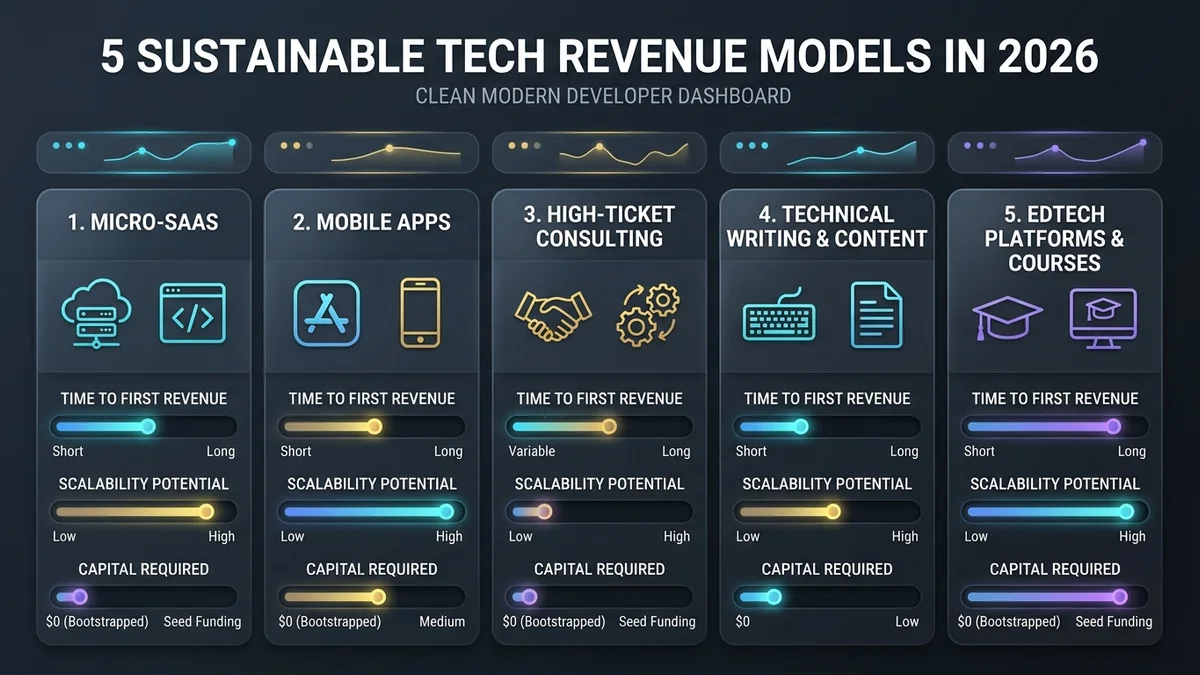
| Revenue Model | Minimum Budget Needed | Time to First $1 | Income Potential (Year 1) | Technical Barrier |
|---|---|---|---|---|
| 1. B2B Micro-SaaS & Niche Tools | $0 – $100 | 2 – 4 months | $1,000 – $10,000 / month (MRR) | High (Full-stack web & APIs) |
| 2. Mobile App Publishing | $25 (Play Store fee) | 1 – 3 months | $500 – $5,000 / month (AdMob/IAP) | Moderate (Kotlin or Flutter) |
| 3. High-Ticket Software Consulting | $0 (Direct outreach) | 2 – 4 weeks | $3,000 – $12,000 / month | High (Specialized engineering) |
| 4. Paid Technical Writing & DevRel | $0 (Free portfolio) | 1 – 3 weeks | $300 – $1,000+ per article | Moderate (Code + writing) |
| 5. Vertical EdTech Platforms | $0 – $50 | 2 – 3 months | $1,000 – $8,000 / month | Moderate (LMS + curriculum) |
2. Overview of the 5 Real Ways to Earn
Model 1: B2B Micro-SaaS & Specialized Tools
A Micro-SaaS is a focused software-as-a-service application built to solve one specific, acute problem for a well-defined niche business audience. Rather than attempting to build the next Salesforce or Slack, Micro-SaaS founders build tools like automated invoice PDF parsers for logistics companies, Webhook inspectors for Shopify stores, or social preview generators.
Because B2B customers use these tools to save hours of manual labor or protect company revenue, charging $19, $49, or $99 per month is trivial for them. With just 50 customers paying $49 per month, your software generates nearly $2,500 in recurring monthly revenue with virtually zero ongoing marginal cost.
Model 2: Mobile App Publishing (Google Play & App Store)
Over 4 billion people carry Android and iOS devices. Mobile users rely on their phones for daily utility: basic math quizzes, resume creation, habit trackers, and localized exam preparation. By publishing native apps in Kotlin or Flutter, you tap directly into global store search traffic without spending a single dollar on outbound advertising.
Monetization combines Google AdMob (banner, interstitial, and rewarded video ads) with In-App Purchases (IAP) or subscription unlocks. Even small utility apps with 20,000 monthly active users frequently generate $600 to $2,500 in steady monthly payouts directly from Google and Apple.
Model 3: High-Ticket Technical Freelancing & Advisory
Generalist web development on platforms like Upwork has become hyper-competitive. However, specialized technical consulting commands extraordinary rates. When an enterprise PostgreSQL database locks up under 10 million rows, or a fintech startup needs to harden Next.js Server Actions against IDOR vulnerabilities, they do not want a $15/hour generalist—they gladly pay $3,000 to $10,000 for a senior engineer who solves the problem in three days.
By niching down into high-concurrency databases, cloud security, or mobile compliance, solo engineers can replace full-time salaries with just two or three high-value retainer clients.
Model 4: Paid Technical Writing & Developer Documentation
Developer tool companies (such as DigitalOcean, Auth0, Supabase, LogRocket, and Cloudflare) compete fiercely for the attention of software engineers. Because traditional marketing fluff does not work on developers, these companies pay independent engineers $300 to $1,000+ per article to write in-depth tutorials, API documentation, and code walkthroughs.
If you have solid coding skills and the ability to explain complex concepts clearly, writing 3 to 4 technical guides per month provides an immediate, reliable income stream with zero startup capital required.
Model 5: Vertical EdTech Platforms & Digital Academies
The era of generic $10 Udemy video courses is fading. In 2026, students and professionals demand interactive, outcome-oriented learning: interactive coding playgrounds, localized board exam prep (like DEESU's Matric Guru), and specialized professional certification platforms.
By building a modern learning platform with gamified progress tracking, automated mock testing, and verifiable certificates, creators build recurring monthly student subscriptions that compound over academic school cycles.
3. What If You Have a $0 Budget? The Zero-Dollar Playbook
The greatest excuse aspiring entrepreneurs use is: *'I don't have enough capital to launch a business.'* In 2026, that excuse is completely invalid. The modern developer ecosystem provides enterprise-grade infrastructure completely free of charge for early-stage builders:
- Hosting & Compute: Cloudflare Pages, Vercel, and Netlify provide generous free tiers that host Next.js, React, and static sites with global CDN edge routing for $0/month.
- Databases & Auth: Supabase and Neon offer free PostgreSQL databases with built-in authentication, row-level security, and connection pooling.
- Payment Processing: Stripe and Lemon Squeezy require zero upfront monthly fees, charging only a small percentage fee per successful transaction.
- Client Portfolio & Distribution: GitHub Pages and Dev.to cost $0 to demonstrate verified code solutions and build domain authority.
If you have $0 in savings today, your recommended sequential strategy is simple: start with Technical Writing or High-Ticket Freelance Consulting to generate immediate cash flow. Reinvest that revenue into custom domains, developer console fees, and server headroom for your Micro-SaaS or Mobile Apps.
4. Summary Execution Roadmap
- Select ONE model that aligns with your current technical strengths (e.g. Kotlin for apps, Next.js for Micro-SaaS, writing for quick cash flow).
- Commit to a 90-day execution sprint without switching ideas halfway through.
- Validate demand before writing code: talk to potential customers, inspect search keywords, and verify people are already spending money on competing solutions.
- Deploy using zero-dollar free tiers to keep overhead at zero until product-market fit is established.
- Study the deep-dive guides linked below for comprehensive step-by-step instructions on each path.
Frequently asked questions
Sources

Written by
Hamza Fazal
Founder, DEESU
Muhammad Hamza Fazal is the Founder of DEESU. An Android and full-stack web developer and digital marketer based in Islamabad, he founded DEESU in May 2022 and leads its engineering operations, product strategy, and client software delivery.
More from HamzaNeed help with this?