
The global market for online developer education has undergone a seismic shift in 2026. Generic introductory programming tutorials—such as basic Python syntax or introductory HTML/CSS—have been largely commoditized by generative AI chatbots and free documentation. However, demand for hyper-specialized, production-grade technical training has reached an all-time high.
Modern engineering teams, junior developers, and career switchers are actively paying premium subscriptions for specialized learning portals that teach real-world architectural workflows: distributed systems resilience, zero-trust cloud security, LLM engineering pipelines, advanced PostgreSQL performance tuning, and high-frequency backend services.
If you have deep software engineering experience, building your own proprietary EdTech platform, digital academy, or interactive learning micro-SaaS allows you to monetize your technical domain knowledge directly. Unlike listing courses on Udemy or Skillshare—where marketplaces take 50% to 63% revenue cuts and force race-to-the-bottom discounts—owning your platform provides 100% pricing control, direct customer relationships, and predictable recurring revenue.
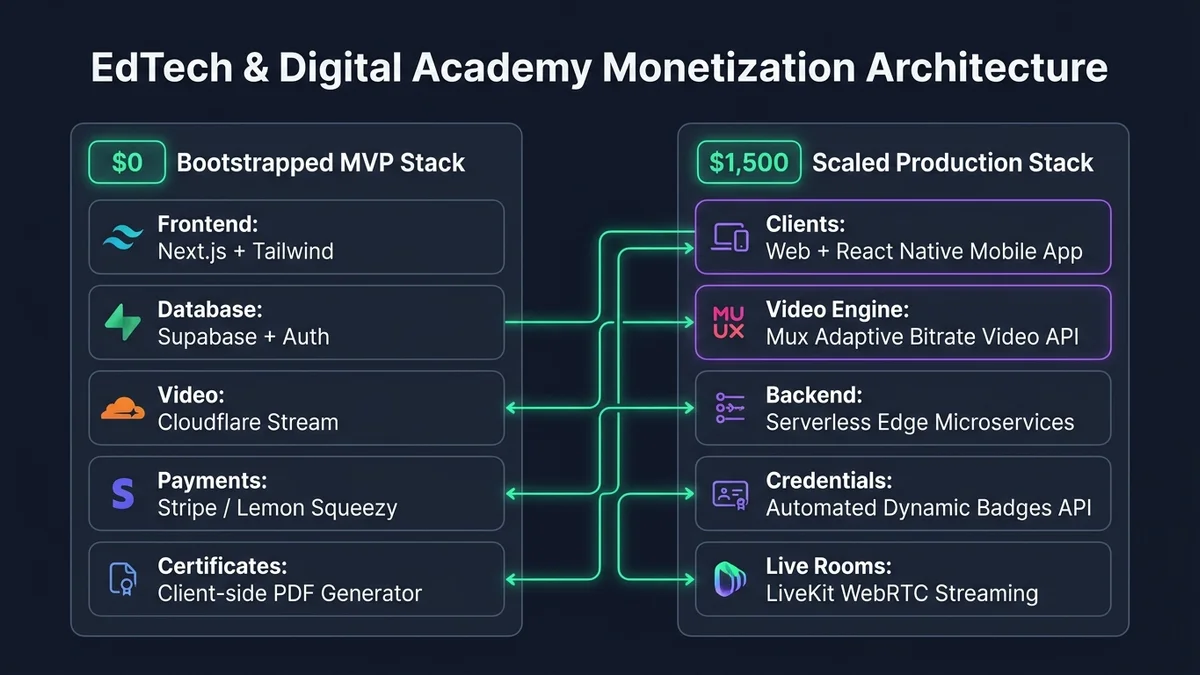
In this comprehensive guide, we examine the real-world economics of launching an EdTech platform in 2026. We provide an exact $0 vs. $1,500 budget breakdown, review the modern full-stack learning architecture, analyze student retention strategies, and walk through step-by-step launch execution.
1. Three Lucrative EdTech Business Models for 2026
Before writing code or recording video lessons, you must choose your platform's monetization model. The three most sustainable architectures in modern technical education are:
- Cohort-Based Intensive Bootcamps ($500 – $2,500 per seat): Students move through a 4 to 8-week curriculum simultaneously. It includes live weekly architectural audits, dedicated Slack/Discord group channels, and final project capstone code reviews. A cohort of just 20 students generates $10,000 to $50,000 in gross revenue with exceptionally high student completion rates.
- Recurring Academy Subscriptions ($29 – $99 per month): A Netflix-style library of in-depth engineering masterclasses, downloadable production starter kits, and exclusive member-only code repositories. Retaining 300 active software engineers at $49/month yields $14,700 MRR in recurring cash flow.
- Self-Paced Single Masterclasses ($99 – $399 one-off): In-depth reference courses focused on a single mission-critical tool or framework (e.g., 'Mastering Distributed Systems with Go and Kafka' or 'Full-Stack Next.js 15 & PostgreSQL'). Provides frictionless purchases with evergreen revenue over multiple years.
2. The Complete Budget Breakdown: $0 Free Tier vs. $1,500 Scale Tier
One of the greatest misconceptions in online education is that launching a platform requires thousands of dollars in commercial LMS software licenses (like Kajabi or Teachable at $150 to $399/month). You can build a superior, custom developer learning portal with zero upfront software costs.
| Infrastructure Layer | The $0 Bootstrap Stack | The $1,500 Scale & Growth Stack | Why It Matters |
|---|---|---|---|
| Domain & Brand | Free subdomain (e.g. vercel.app or GitHub Pages) | $12/year (.com or .org via Cloudflare Registrar) | Custom domains build institutional trust and credibility. |
| Web Application Hosting | Vercel / Cloudflare Pages Free Tier ($0) | Vercel Pro ($20/mo) or Hetzner VPS ($6/mo) | Handles high concurrent student traffic with zero cold starts. |
| Database & User Auth | Supabase Free Tier (500MB DB, 50k monthly active users) | Supabase Pro ($25/mo) with daily automated backups | Stores user profiles, lesson completion flags, and enrollment state. |
| Video Streaming & Hosting | YouTube Unlisted or Mux Free Tier ($0) | Bunny.net Stream / Cloudflare Stream ($10 – $30/mo) | Provides tokenized HLS streaming with dynamic DRM & watermark. |
| Payment Processing | Stripe Checkout / Lemon Squeezy (0 upfront, 2.9% + 30¢) | Stripe Billing + LemonSqueezy Merchant of Record | Handles multi-currency payments, global VAT, and auto-invoicing. |
| Community & Discussion | Discord Free Server or GitHub Discussions ($0) | Self-hosted Discourse or Circle.so ($49/mo) | Facilitates peer debugging, code reviews, and networking. |
| Marketing & Seed Ads | $0 (Technical writing, LinkedIn, X, open source) | $1,000 targeted search & developer sponsor ads | Kickstarts initial cohort enrollment and email subscriber list. |
| Total Estimated Cost | $0 Upfront Investment | $1,120 – $1,500 Initial Investment | Both paths scale efficiently to thousands of active learners. |
3. What to Do If You Have Exactly $0 to Start
If you have zero capital, your primary asset is your engineering expertise and sweat equity. Here is the verified step-by-step roadmap to launch a profitable technical academy with zero money out of pocket:
- Deploy an Open-Source LMS Template ($0): Clone a modern, MIT-licensed Next.js 15 course starter kit (utilizing Tailwind CSS, Shadcn UI, and Supabase). Deploy directly to Vercel's free tier with automated GitHub CI/CD pipelines.
- Host Video Content Securely for Free ($0): Record your terminal and screen using OBS Studio (free and open-source). Upload lessons to YouTube as unlisted videos and embed them using an iframe with disabled related videos and disabled keyboard controls, or utilize Mux's free development credits.
- Integrate Stripe Payment Links ($0): You do not need complex recurring billing logic to start. Create two Stripe Payment Links in your Stripe dashboard for your course tiers. Configure a Stripe webhook to toggle
has_access: trueon the student's profile record in Supabase upon successful payment. - Build Organic Authority Through Technical Guides ($0): Write 3 high-value, problem-solving technical tutorials on your engineering blog or LinkedIn (e.g., 'How We Reduced PostgreSQL Query Latency by 92%'). At the conclusion of the article, provide a call to action directing readers to enroll in your comprehensive masterclass.
- Reinvest Initial Revenue: When your first 5 students enroll (generating $500 to $1,500 in revenue), immediately reinvest into a custom domain, professional Bunny.net video encoding, and dedicated audio equipment.
4. Modern LMS Technical Architecture & Database Schema
A high-performance technical learning platform requires a robust relational database schema to track student enrollments, module progressions, quiz submissions, and active subscription states. Below is a production-ready PostgreSQL schema designed for Supabase:
-- Course and Module Hierarchy
CREATE TABLE courses (
  id UUID PRIMARY KEY DEFAULT gen_random_uuid(),
  slug TEXT UNIQUE NOT NULL,
  title TEXT NOT NULL,
  description TEXT,
  price_cents INTEGER NOT NULL DEFAULT 0,
  is_published BOOLEAN NOT NULL DEFAULT false,
  created_at TIMESTAMPTZ NOT NULL DEFAULT now()
);

CREATE TABLE modules (
  id UUID PRIMARY KEY DEFAULT gen_random_uuid(),
  course_id UUID REFERENCES courses(id) ON DELETE CASCADE,
  title TEXT NOT NULL,
  order_index INTEGER NOT NULL,
  is_preview_allowed BOOLEAN NOT NULL DEFAULT false
);

CREATE TABLE lessons (
  id UUID PRIMARY KEY DEFAULT gen_random_uuid(),
  module_id UUID REFERENCES modules(id) ON DELETE CASCADE,
  title TEXT NOT NULL,
  slug TEXT NOT NULL,
  video_playback_id TEXT, -- Mux playback ID or Bunny.net GUID
  duration_seconds INTEGER DEFAULT 0,
  markdown_content TEXT,
  order_index INTEGER NOT NULL
);

-- Student Enrollment and Progress Tracking
CREATE TABLE enrollments (
  id UUID PRIMARY KEY DEFAULT gen_random_uuid(),
  user_id UUID REFERENCES auth.users(id) ON DELETE CASCADE,
  course_id UUID REFERENCES courses(id) ON DELETE CASCADE,
  stripe_customer_id TEXT,
  stripe_subscription_id TEXT,
  status TEXT NOT NULL DEFAULT 'active', -- active, past_due, canceled
  enrolled_at TIMESTAMPTZ NOT NULL DEFAULT now(),
  UNIQUE(user_id, course_id)
);

CREATE TABLE lesson_progress (
  id UUID PRIMARY KEY DEFAULT gen_random_uuid(),
  user_id UUID REFERENCES auth.users(id) ON DELETE CASCADE,
  lesson_id UUID REFERENCES lessons(id) ON DELETE CASCADE,
  completed BOOLEAN NOT NULL DEFAULT false,
  completed_at TIMESTAMPTZ,
  last_watched_second INTEGER DEFAULT 0,
  UNIQUE(user_id, lesson_id)
);
5. Solving the Video Piracy Challenge with Tokenized Streaming
In developer education, screen scraping and raw video downloading are common threats. Simply pasting raw .mp4 URLs inside an HTML <video> tag allows any user to inspect network traffic and download your entire course in seconds.
To protect your intellectual property, use HLS (HTTP Live Streaming) with signed tokens. Instead of serving a static file, the browser requests an encrypted .m3u8 playlist. Each chunk (.ts video fragment) requires a time-expiring cryptographic hash generated by your backend server based on the student's authenticated IP address and user ID.
Services like Bunny Stream or Cloudflare Stream handle this encoding automatically for less than $0.005 per gigabyte of transferred video data, making enterprise-grade anti-piracy accessible even to independent bootstrapped educators.
6. How to Achieve 60%+ Completion Rates (The Secret to Retention)
The average completion rate across mass-market MOOCs (Coursera, Udemy) hovers between 3% and 7%. When students fail to complete courses, they request refunds, leave negative reviews, and cancel monthly subscriptions. To maintain a thriving digital academy with sub-3% churn, implement these three modern engagement mechanics:
- Interactive In-Browser Code Sandboxes: Embed WebContainers or sandboxed WebAssembly execution environments (like StackBlitz or Monaco Editor) directly alongside lesson videos. Students can test concepts instantly without fighting local environment configuration issues.
- Automated Milestone Testing: Require students to pass an automated test suite (e.g. submitting a PR to a verification bot or passing a test runner) before the next course module unlocks. Engineers love gamified progression.
- Weekly Office Hours & Asynchronous Code Reviews: Offer a private tier where you review student GitHub pull requests once per week. Personal constructive feedback transforms passive consumers into passionate advocates.
7. Step-by-Step 30-Day Launch Roadmap
Follow this structured timeline to take your educational platform from concept to initial paying customers within one month:
- Days 1–7 (Topic Validation & Pre-Selling): Define your curriculum outline. Create a simple landing page announcing the course with an early-bird 50% discount. Share your outline on LinkedIn and engineering communities. If 5 to 10 people pre-order, your topic is validated.
- Days 8–18 (Curriculum Recording & Code Assets): Record 3 to 5 hours of dense, no-fluff technical lessons. Build a complete, production-ready GitHub repository with step-by-step git commits corresponding to each chapter.
- Days 19–24 (Platform Deployment & Billing Configuration): Deploy your Next.js application, configure Supabase authentication, upload video streams, and test Stripe webhooks using Stripe CLI in test mode.
- Days 25–30 (Official Launch & Cohort Kickoff): Email your pre-order customers their access credentials. Publish two comprehensive companion technical guides on your blog and social channels driving traffic to the launch promotion.
Frequently asked questions

Written by
Hamza Fazal
Founder, DEESU
Muhammad Hamza Fazal is the Founder of DEESU. An Android and full-stack web developer and digital marketer based in Islamabad, he founded DEESU in May 2022 and leads its engineering operations, product strategy, and client software delivery.
More from Hamza