
The traditional software startup playbook is broken. For years, founders believed you needed to raise a $1.5 million seed round, hire five engineers, burn through cash in high-rent offices, and spend eighteen months building a monolithic enterprise platform before earning your first dollar.
In 2026, the solo developer and small agile team have completely upended this dynamic through Micro-SaaS. A Micro-SaaS is a laser-focused cloud application built, maintained, and grown by an individual engineer or a two-person team. By targeting narrow, underserved business problems, solo founders routinely generate $3,000 to $15,000 in monthly recurring revenue (MRR) with profit margins exceeding 85%.
Whether you want to escape client services, build an independent income stream, or bootstrap a software asset, this guide provides the exact operational blueprint: product validation, modern architecture, client acquisition, and an honest financial breakdown comparing The $0 Bootstrap Path against The $1,000 Growth Path.
1. What Makes a Winning Micro-SaaS Idea in 2026?
The #1 fatal mistake novice founders make is building a 'horizontal' consumer product (e.g. another generic to-do list, social network, or AI copywriter). Consumer software suffers from brutal churn, low willingness to pay ($5/month feels expensive to consumers), and massive customer support overhead.
Winning Micro-SaaS products are strictly B2B and highly vertical. They solve acute friction in existing workflows where money is already moving:
- API Integration & Webhook Monitoring: Tools that alert Shopify or Stripe merchants the instant a webhook fails, preventing lost order revenue.
- Regulatory & Compliance Generators: Automated PDF generator services producing GDPR, CCPA, or Google Play-compliant policies for mobile app publishers.
- Data Transformation & Formatting Micro-Tools: Instant converters turning legacy CSV banking exports into modern accounting formats (QuickBooks/Xero).
- Platform-Specific Add-ons: Specialized Shopify apps, Notion integrations, or Figma plugins that automate tedious designer and merchant tasks.
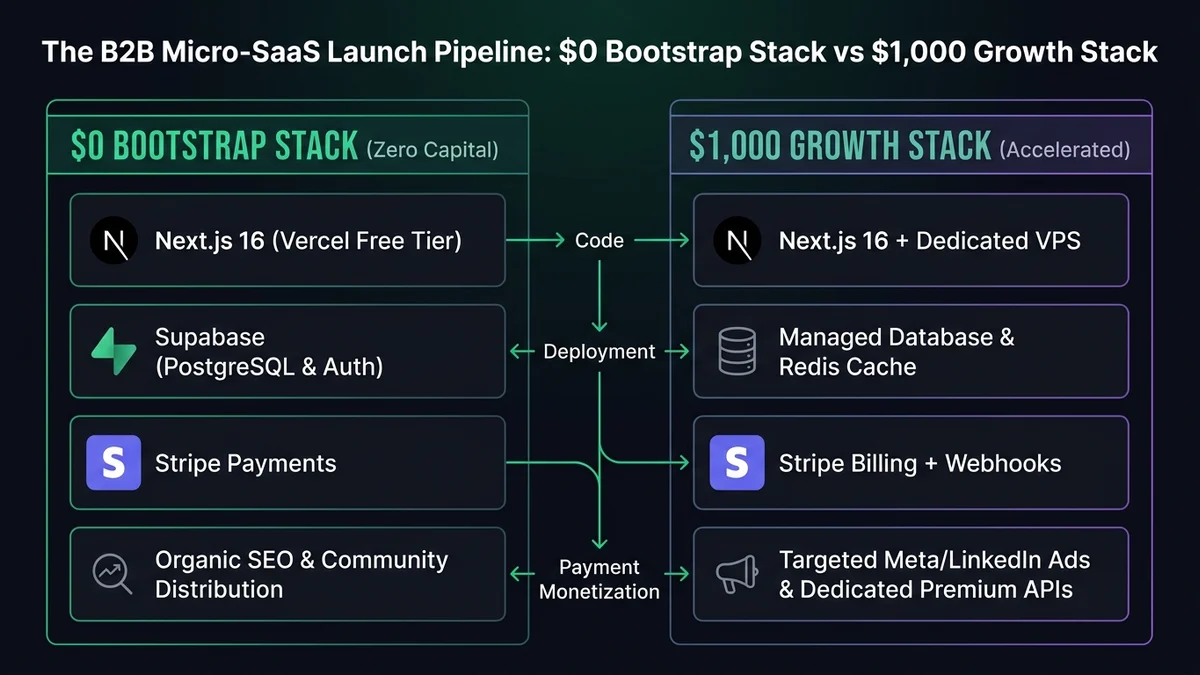
2. The $0 Bootstrap Budget Blueprint
What if your bank account has literally zero dollars to invest? In 2026, you can engineer and deploy a world-class, SOC2-compliant B2B SaaS without spending a single cent upfront:
| Infrastructure Layer | Recommended Free-Tier Provider | Monthly Cost | Limits & Scale Allowance |
|---|---|---|---|
| Web Frontend & Serverless Compute | Vercel / Cloudflare Pages | $0.00 | 100k+ monthly requests, global edge CDN |
| Database & User Auth | Supabase (PostgreSQL) | $0.00 | 500MB database, 50,000 monthly active users |
| Domain Name & SSL | Free subdomain (e.g. *.vercel.app) or GitHub Pages | $0.00 | Full HTTPS certificate included free |
| Transactional Email | Resend / Brevo Free Tier | $0.00 | Up to 3,000 onboarding emails / month |
| Billing & Invoicing | Stripe / Lemon Squeezy | $0.00 upfront | Pay-as-you-grow (2.9% + 30¢ per charge) |
| Total Initial Capital Needed | The $0 Stack | $0.00 | Sufficient to reach your first $1,000 MRR |
On the $0 path, your only investment is your engineering time. You use your platform's free subdomain while you validate product demand. You write code in Next.js 16 with TypeScript and Tailwind CSS, secure database rows with Supabase Row Level Security (RLS), and wire Stripe Checkout for credit card billing.
3. The $1,000 Growth Budget: Where to Allocate Capital
If you have savings or freelance earnings to invest, a $1,000 budget dramatically accelerates your credibility, discovery velocity, and customer conversion rates:
- Custom Domain (.com / .io): $12 – $35 / year: A professional branded domain (via Cloudflare Registrar) establishes trust with business buyers who refuse to enter credit cards on free subdomains.
- Google Workspace Business Email: $72 / year ($6/mo): Sending support emails from
support@yourdomain.comrather than a personal Gmail address boosts email deliverability to 99%. - Targeted Search Ads (Google Search Intent): $500: Bidding strictly on high-intent exact-match keywords (e.g. *'shopify webhook failed alert tool'*) sends 200–300 ready-to-buy businesses directly to your landing page.
- Micro-Influencer & Curated Directory Submissions: $200: Listing on specialized software directories (Uneed, Betalist, MicroLaunch) and sponsoring a niche developer newsletter.
- Emergency Server & Buffer Reserve: $180: Safety buffer for cloud scaling when your database hits production traffic.
4. The Modern Production Tech Stack for Solo Founders
Avoid shiny object syndrome. Do not waste three weeks evaluating obscure frameworks. The standard, battle-tested production stack for Micro-SaaS in 2026 is:
// Stack Definition: Fast, Type-Safe, Cost-Efficient
const MicroSaaSStack = {
  frontend: "Next.js 16 (App Router) + React 19",
  styling: "Tailwind CSS + Radix UI primitives",
  database: "PostgreSQL on Supabase (with Row Level Security)",
  orm: "Drizzle ORM or Prisma (Type-safe SQL schema)",
  auth: "Supabase Auth (Magic Links + Google OAuth)",
  payments: "Stripe Billing (Subscription webhooks)",
  hosting: "Vercel / Cloudflare Workers",
  monitoring: "Sentry (Error logging) + PostHog (Product analytics)",
};
This architecture compiles into lightweight edge functions that cost virtually nothing during low-traffic periods but scale effortlessly when an article or launch goes viral.
5. Customer Acquisition: How to Get Your First 10 Paying Customers
Building the software is only 40% of the battle; distribution is the remaining 60%. Solo founders cannot afford expensive PR agencies. Instead, execute this 3-step acquisition flywheel:
- Direct Value-Add Community Outreach: Search Reddit, Discord communities, and X for people actively complaining about the specific problem your tool solves. Reply with genuine, actionable advice and offer a free lifetime beta account in exchange for 15 minutes of feedback.
- Programmatic SEO Free Tools: Build a free, lightweight interactive calculator or validator related to your product (similar to DEESU's free developer tools). Free tools attract organic Google backlinks and rank for high-intent technical keywords.
- Build in Public with Transparent Metrics: Share your technical architectural decisions, revenue screenshots, and development hurdles on LinkedIn and X. Technical founders love supporting fellow builders.
6. Summary 90-Day Execution Timeline
- Days 1 – 14 (Validation): Talk to 10 potential business users. Confirm the problem exists and that they currently pay for an inferior workaround.
- Days 15 – 45 (Build Minimum Viable Product): Build the core feature that solves the primary pain point. Eliminate secondary settings and profile customizations.
- Days 46 – 60 (Stripe Integration & Closed Beta): Onboard 10 beta testers. Ensure payments process smoothly and fix critical bugs.
- Days 61 – 90 (Public Launch & Distribution): Launch on Product Hunt, Hacker News, and targeted developer subreddits. Focus 100% of energy on customer retention.
Frequently asked questions
Sources

Written by
Hamza Fazal
Founder, DEESU
Muhammad Hamza Fazal is the Founder of DEESU. An Android and full-stack web developer and digital marketer based in Islamabad, he founded DEESU in May 2022 and leads its engineering operations, product strategy, and client software delivery.
More from HamzaNeed help with this?