
When React 19 and Next.js introduced Server Actions, full-stack web development underwent an ergonomic revolution. With a single 'use server' directive, frontend engineers could invoke backend mutations directly from a <form> or button click without manually writing API routes, managing Axios instances, or serialization glue.
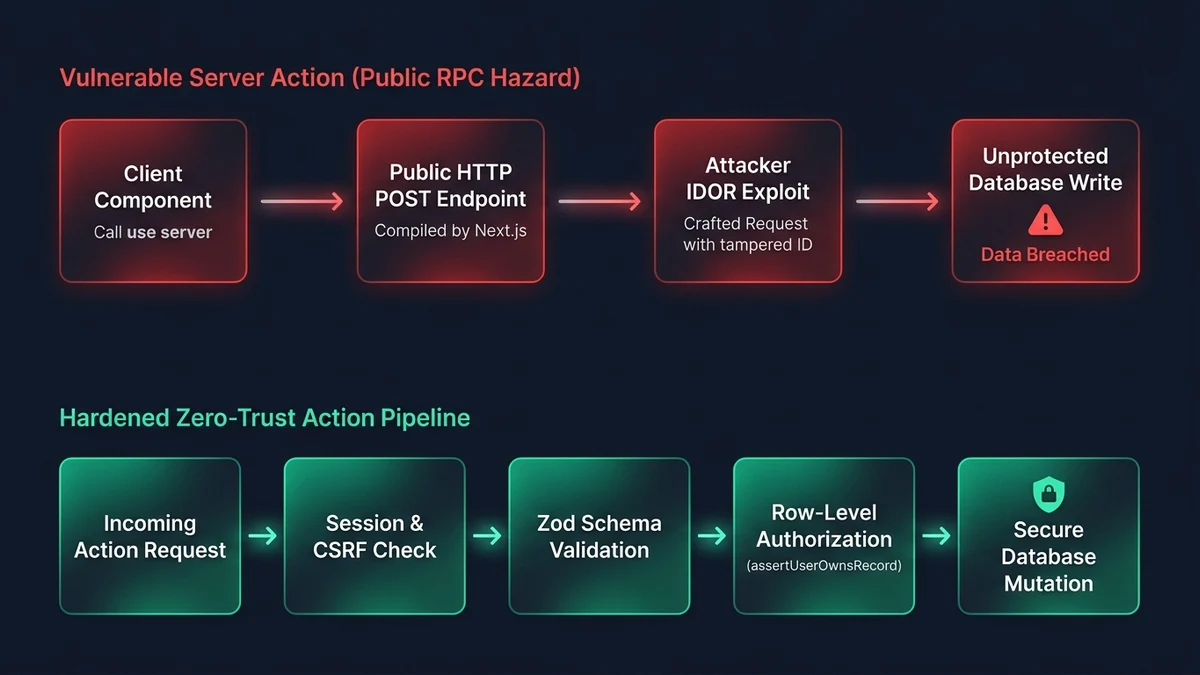
However, this seamless syntax created an insidious psychological hazard: The Illusion of Private Functions. Because Server Actions look and feel like standard JavaScript functions imported into React components, developers routinely forget that every Server Action is, in reality, a completely public, unauthenticated HTTP POST endpoint exposed to the entire internet.
In late 2026 application security assessments, penetration testers found that over 45% of enterprise Next.js applications contained critical authorization bypasses, privilege escalation flaws, or data exfiltration leaks inside their Server Actions. Attackers do not click your UI buttons—they inspect your network tab, grab the hidden action ID, and fire direct HTTP POST payloads with arbitrary arguments.
If your application relies on Server Actions for checkout, user settings, data deletion, or administrative toggles, you must understand how these endpoints are compiled and fortified. In this guide, we break down the top 3 Server Action vulnerabilities and establish a production-grade verification architecture.
1. The Under-The-Hood Reality: How Next.js Compiles 'use server'
To understand why Server Actions are susceptible to attack, examine what Next.js does during next build. When the compiler encounters a function tagged with 'use server', it does not keep that function bound to your component. Instead, it performs the following transformation:
- Generates a Cryptographic Action ID: A unique hash representing that function is registered in an internal manifest (e.g.
a6f028b17a). - Exposes a Global Dispatcher Endpoint: Next.js mounts a catch-all HTTP handler that responds to POST requests bearing the
Next-Action: <action-id>HTTP header. - Deserializes Arguments: When a POST request arrives, the server deserializes the raw body arguments and passes them directly to your function.
2. The Top 3 Server Action Vulnerabilities
Vulnerability A: Insecure Direct Object References (IDOR)
The most frequent vulnerability occurs when an action trusts client-supplied identifiers. Consider a profile update action:
// VULNERABLE SERVER ACTION
"use server";

export async function updateAccountSettings(userId: string, newEmail: string) {
  // FATAL FLAW: Blindly trusts the client-provided userId!
  await db.user.update({
    where: { id: userId },
    data: { email: newEmail },
  });
}An attacker simply invokes this action, replaces userId with the account ID of the company CEO, and hijacks the administrative account. The Server Action must never accept the user ID from the client—it must extract the user ID exclusively from the verified server-side session cookie.
Vulnerability B: Unvalidated Payloads & Parameter Injection
Because TypeScript types vanish at runtime, passing raw arguments to your database queries allows attackers to inject unexpected data types, bypass business rules, or trigger database crashes. If an action expects a positive integer for a quantity, an attacker can pass -50 to receive a negative invoice balance.
Vulnerability C: Hidden State Leaks in Closures
When a Server Action is defined inside a Server Component file, it can close over variables in the surrounding scope. In early React 19 releases, closing over sensitive server-side variables (such as API keys or user addresses) can cause React to serialize those variables and send them to the client as encrypted bound arguments. If an encryption key leaks or an attacker intercepts the payload, sensitive backend state is exposed.
3. CSRF and Origin Protection in Next.js 16
In traditional web development, POST mutations require explicit CSRF tokens stored in cookies. Next.js 16 simplifies this by leveraging modern browser protections:
- Automatic Origin Verification: When a Server Action is invoked via a standard POST request, Next.js compares the incoming
Originheader against theHostheader. If they do not match, the action is rejected immediately with a 403 Forbidden. - Cross-Site Form Submissions: Standard
<form action={serverAction}>tags in modern browsers cannot forge cross-origin POST mutations without triggering the Origin mismatch check. - Reverse Proxy Header Forwarding: If your application sits behind Cloudflare, AWS CloudFront, or an NGINX reverse proxy, ensure your proxy forwards the
HostandX-Forwarded-Hostheaders accurately. Misconfigured proxy headers will cause Next.js to reject legitimate user mutations.
4. Production Implementation: Hardened Server Action Pattern
Below is the production-grade, zero-trust pattern for Server Actions used by DEESU. It incorporates session verification, Zod runtime schema validation, and row-level ownership checks:
"use server";

import { z } from "zod";
import { auth } from "@/lib/auth"; // Your verified session helper (e.g. NextAuth/Lucia)
import { db } from "@/lib/db";

// 1. Define strict Zod validation schema
const UpdateProfileSchema = z.object({
  displayName: z.string().min(2).max(50),
  bio: z.string().max(500).optional(),
  notifyOnBilling: z.boolean(),
});

export type UpdateProfileInput = z.infer<typeof UpdateProfileSchema>;

export async function updateProfileSecure(rawInput: unknown) {
  // 2. Authentication Check: Verify session on server
  const session = await auth();
  if (!session || !session.user || !session.user.id) {
    throw new Error("Unauthorized: Active session required.");
  }

  // 3. Runtime Schema Validation with Zod: Strips unknown malicious fields
  const parseResult = UpdateProfileSchema.safeParse(rawInput);
  if (!parseResult.success) {
    return {
      success: false,
      errors: parseResult.error.flatten().fieldErrors,
    };
  }

  const { displayName, bio, notifyOnBilling } = parseResult.data;

  try {
    // 4. Row-Level Authorization: Mutate ONLY records owned by session.user.id
    const updated = await db.user.update({
      where: {
        id: session.user.id, // Sourced from verified session, NEVER from client input!
      },
      data: {
        name: displayName,
        bio: bio ?? null,
        notifyBilling: notifyOnBilling,
      },
    });

    return { success: true, data: { name: updated.name } };
  } catch (err: any) {
    console.error(`[ACTION_ERROR] Failed to update profile: ${err.message}`);
    return { success: false, message: "Internal server error occurred." };
  }
}5. The 2026 Next.js Server Action Hardening Checklist
- Treat every 'use server' function as a public API endpoint: assume attackers can call it with any arguments.
- Never accept user IDs, role permissions, or tenant IDs as arguments: extract them from the verified session.
- Validate 100% of incoming arguments using Zod schemas to strip unauthorized properties.
- Enforce Row-Level Authorization (RLS) inside database queries: check ownership before updating or deleting.
- Verify reverse proxy configurations (NGINX/Cloudflare) forward Host and X-Forwarded-Host headers accurately.
- Avoid defining Server Actions inside component closures: export them from dedicated action files (e.g. actions.ts).
Frequently asked questions
Sources

Written by
Hamza Fazal
Founder, DEESU
Muhammad Hamza Fazal is the Founder of DEESU. An Android and full-stack web developer and digital marketer based in Islamabad, he founded DEESU in May 2022 and leads its engineering operations, product strategy, and client software delivery.
More from HamzaFree tools for this topic
Need help with this?