
Every software engineer who attempts freelancing encounters the same soul-crushing barrier. You sign up for Upwork, Freelancer, or Fiverr, search for web development projects, and find client posts like: *'Need full-stack Uber clone in React Native and Node.js. Budget: $150.'* Within twenty minutes of posting, that job receives forty bids from offshore agencies bidding $10 per hour.
Competing on price as a generalist is an unwinnable race to the bottom. In 2026, AI coding tools have made basic code generation a commodity. If your sales pitch is merely *'I can write React code'* or *'I build websites'*, clients will treat you as an interchangeable expense.
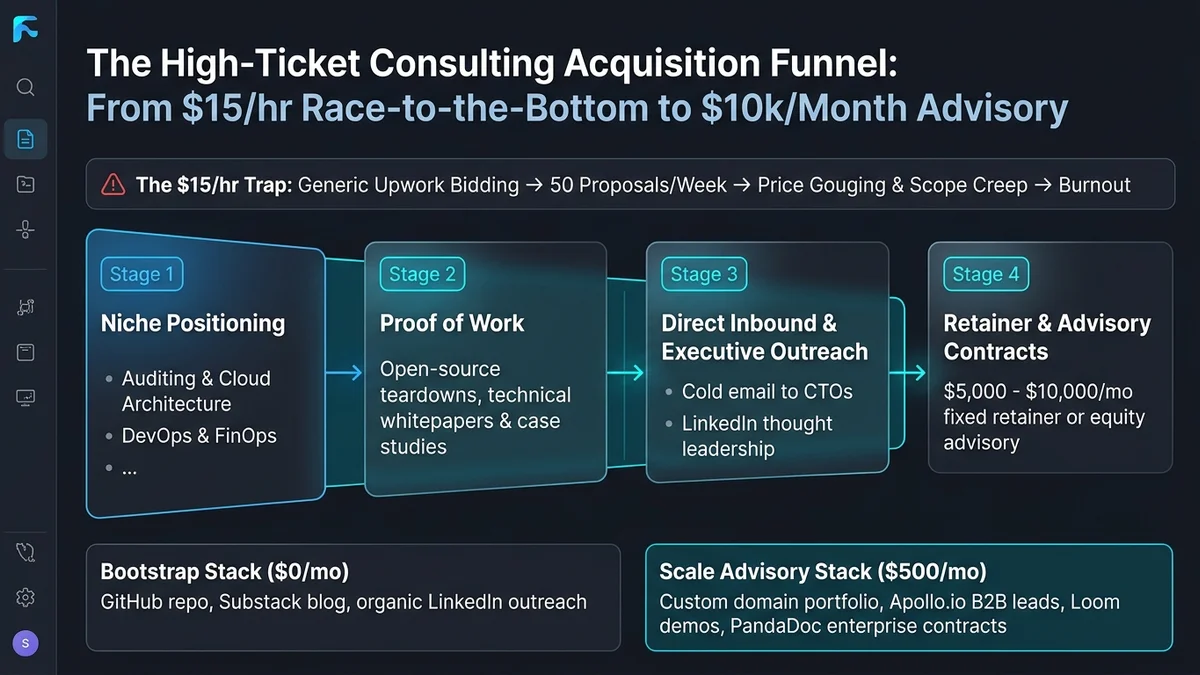
However, on the other end of the software economy, growing tech startups, fintech companies, and funded agencies are desperately seeking Specialized Technical Consultants. When a database locks up under 10 million concurrent rows, or when an engineering team must migrate legacy Docker infrastructure to hardened cloud clusters, they don't want a cheap generalist—they happily pay $5,000 to $15,000 to a specialized consultant who can diagnose and fix the issue in four days.
In this comprehensive guide, we reveal how senior developers escape the gig-platform trap, establish specialized technical authority, close five-figure client engagements, and scale to $10,000+ per month—even if you are starting with zero dollars in your business account today.
1. The Fundamental Shift: Generalist vs. Specialized Consultant
The difference between earning $25/hour and billing $150+/hour is not how many programming languages you know; it is how narrowly you position your technical solution against an expensive business problem:
| Positioning Dimension | Low-Rate Generalist ($15 - $35/hr) | High-Ticket Specialist ($100 - $250/hr) |
|---|---|---|
| Headline / Pitch | 'Full-Stack Web & Mobile Developer' | 'PostgreSQL Concurrency & High-Scale Database Architect' |
| Client Type | Price-sensitive individuals & micro-businesses | Funded SaaS founders, CTOs, & e-commerce directors |
| Sales Channel | Competitive bidding sites (Upwork, Fiverr) | Direct outbound audits, LinkedIn breakdowns, & GitHub repos |
| Pricing Model | Hourly billing (punishes working quickly) | Fixed-price value milestones & monthly retainers |
| Client Perception | Interchangeable contractor / cost center | Strategic technical partner / revenue protector |
2. The $0 Budget Launch Strategy: Winning Your First Enterprise Client
You do not need to spend money on Google ads, fancy agency websites, or expensive sales automation tools. Here is the exact zero-dollar outbound playbook:
Step 1: Build One Definitive 'Proof of Work' Asset ($0)
Instead of a generic portfolio with five cookie-cutter clone apps, build one deep, public technical asset on GitHub or your blog. For example, publish a verified benchmark comparing Redis locking algorithms under 50,000 simulated requests, or a comprehensive guide on securing Next.js Server Actions with Zod schemas.
Step 2: The Free 5-Minute Technical Teardown ($0)
Identify 15 funded startups or fast-growing e-commerce stores in your niche. Inspect their public web app: run their store through PageSpeed Insights, inspect their network tab for unnecessary re-renders or uncompressed assets, or audit their mobile app's Play Store metadata.
Record a 3-minute personalized Loom video (or write a concise 4-bullet point audit):
Subject: Found 2 query bottlenecks in [Company]'s checkout API

Hi [Founder/CTO Name],

I was testing your checkout flow and noticed your API takes 2.4s to return
during peak hours. Looking at your public bundles, it appears your backend
is running unindexed foreign key lookups on orders.

I recorded a 3-minute video showing the exact database fix we used to cut
query latency from 2,400ms to 45ms for an e-commerce platform with 10M rows:
[Loom Video Link]

No strings attached—hope this helps your team improve conversion rates!

Best,
[Your Name] | PostgreSQL Concurrency Specialist
Because you delivered immediate, objective technical value without aggressively begging for money, your reply rate will be 25% to 40%. The conversation naturally transitions into: *'Can we hire you to fix this for us?'*
3. The $500 Scale Budget: Elevating Professional Infrastructure
Once your first client engagement closes, reinvesting $500 dramatically increases your conversion rates and closes larger contract sizes:
| Tool / Asset | Cost | Purpose & Return on Investment |
|---|---|---|
| Custom Domain (.org / .com) on Cloudflare | $12 / year | Essential credibility for corporate and enterprise procurement |
| Google Workspace Email (you@yourdomain.com) | $6 / month | Ensures proposals and contract drafts don't land in spam folders |
| Apollo.io / LinkedIn Sales Navigator (1 month) | $79 / month | Pinpoints exact email addresses of CTOs at funded Series A/B startups |
| Contract & SOW Legal Templates | $150 one-time | Enforceable intellectual property, liability limits, and payment terms |
| Total Scaling Budget | $247 – $500 | Enables consistent $5,000 – $10,000 monthly consulting pipelines |
4. Pricing Strategy: Escaping the Hourly Trap
Never bill by the hour for high-ticket consulting. Hourly billing creates an adversarial relationship: the faster and more proficient you are at solving the client's problem, the less money you earn.
Structure your services into two distinct high-ticket packages:
- The Fixed-Price Architecture Sprint ($3,500 – $7,500): A 1-to-2 week intensive engagement where you diagnose, audit, and refactor a specific mission-critical subsystem (e.g. database indexing overhaul, container security hardening, or mobile background sync migration).
- The Ongoing Advisory Retainer ($3,000 – $5,000 / month): A dedicated monthly package providing 10–15 hours of architectural reviews, PR audits, and on-call escalation for their core engineering team. Just two retainer clients provide a stable $6,000 to $10,000 monthly baseline.
5. Summary 30-Day Transition Roadmap
- Days 1 – 7 (Niche Selection): Choose ONE high-stakes technical specialty (e.g. Next.js performance, Android background sync, or PostgreSQL concurrency).
- Days 8 – 14 (Proof of Work): Publish a detailed case study or open-source GitHub tool solving that exact problem.
- Days 15 – 25 (Outbound Audits): Send 25 personalized, value-first technical teardowns to founders and engineering directors.
- Days 26 – 30 (Proposal & Closing): Conduct discovery calls, scope deliverables using fixed milestones, and collect a 50% upfront deposit before writing code.
Frequently asked questions
Sources

Written by
Hamza Fazal
Founder, DEESU
Muhammad Hamza Fazal is the Founder of DEESU. An Android and full-stack web developer and digital marketer based in Islamabad, he founded DEESU in May 2022 and leads its engineering operations, product strategy, and client software delivery.
More from HamzaNeed help with this?