
Every software engineering team begins with a simple crontab. You launch a virtual machine, edit /etc/crontab via SSH, add 0 0 * * * /usr/bin/python3 backup.py, and walk away feeling accomplished. For a single server running a side project, that simple script works flawlessly for months.
Then your application grows. You containerize your backend with Docker, migrate to a Kubernetes cluster or AWS ECS, configure an autoscaling group with a minimum of four pods, and suddenly a quiet disaster strikes at midnight: your monthly billing script executes four times simultaneously. Four thousand customers are billed twice, payment gateways flag your merchant account for suspicious fraud, and your primary PostgreSQL database grinds to a halt under transaction lock contention.
In modern cloud engineering, distributed background job scheduling is not a simple matter of time syntax. It is a distributed systems consensus problem. In this architectural guide, we explore why traditional cron breaks in cloud clusters, examine how to achieve atomic mutual exclusion with Redis distributed locks, and establish production patterns for idempotency and graceful failure recovery.
1. The Multi-Instance Race Condition Hazard
Why does standard scheduling fail in containerized environments? When an autoscaler scales your service from one replica to five, it duplicates everything inside the image—including any embedded cron daemons or in-memory schedulers (like node-cron or Python schedule).
Because all instances share the same system clock synchronized via NTP, every instance triggers the scheduled event at the exact same millisecond. Without explicit coordination, this triggers the Multi-Instance Race Condition:
- Duplicate Financial Transactions: Processing subscriptions multiple times for the same billing cycle.
- Email & Push Notification Storms: Bombarding users with identical notification payloads.
- Database Lock Contention: Multiple instances running
UPDATEqueries on the same unindexed table rows, escalating into deadlocks. - Third-Party API Rate Limit Penalties: Exceeding external rate quotas (e.g. OpenAI, Stripe, SendGrid) in seconds.
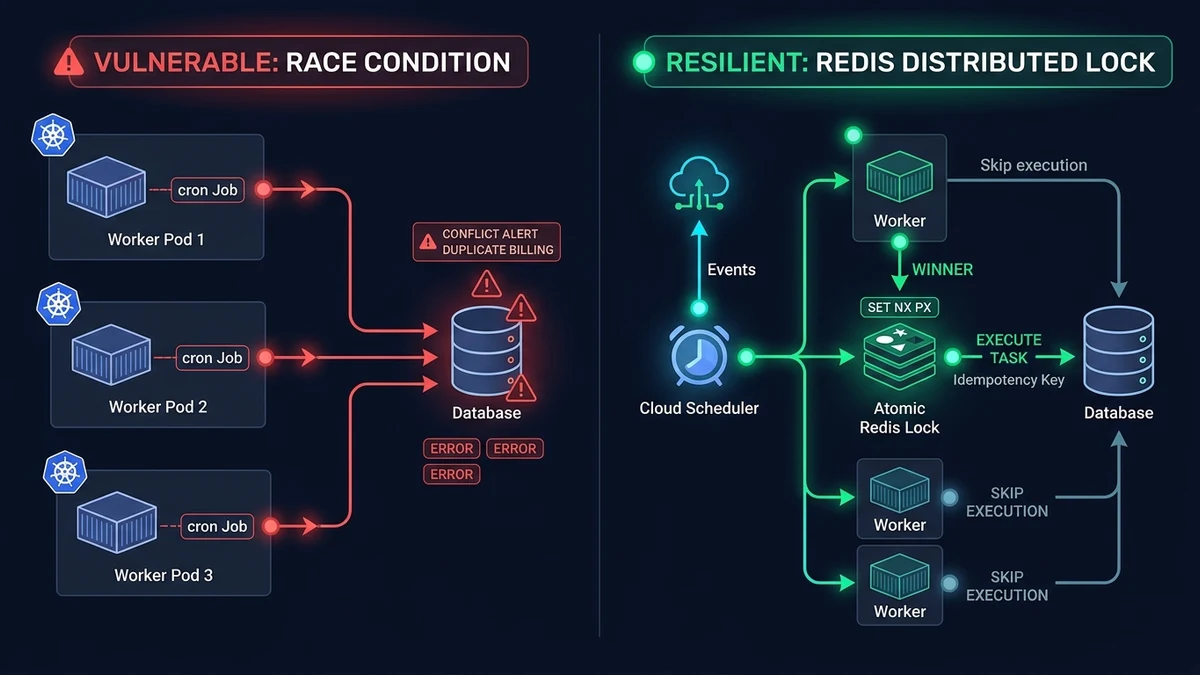
2. Atomic Mutual Exclusion: The Redis Distributed Lock Pattern
To guarantee that exactly one instance executes a scheduled task, distributed systems require an atomic lock coordination layer. Redis is ideally suited for this due to its single-threaded in-memory execution and atomic primitives.
The Atomic Lock Algorithm (SET NX PX)
In production, an instance attempts to acquire a lock using Redis's atomic SET command with two critical flags: NX (only set if key does not already exist) and PX (set an automatic expiration in milliseconds):
SET lock:cron:daily_billing "unique_worker_uuid_9921" NX PX 60000If Redis returns OK, that worker instance won the race and holds exclusive permission to execute the job. If Redis returns nil, another worker already holds the lock, and the current instance immediately acknowledges the event and sleeps without doing work.
3. The Idempotency Imperative
Distributed locks prevent simultaneous executions, but they cannot protect against network timeouts, worker crashes during execution, or message broker retries. For complete system safety, every scheduled background job must be strictly idempotent.
An operation is idempotent if executing it multiple times produces the exact same side-effects as executing it once. In financial and data processing pipelines, idempotency is enforced through Deterministic Idempotency Keys:
| Workload Type | Idempotency Key Strategy | Failure Recovery Action |
|---|---|---|
| Subscription Billing | invoice_rec_{user_id}_{YYYY_MM} | Unique DB constraint prevents double-charging |
| Daily Summary Email | email_digest_{user_id}_{YYYY_MM_DD} | Check sent_logs table before invoking SendGrid API |
| Database Backup | db_snapshot_{database_name}_{YYYY_MM_DD} | Overwrite or append incremental snapshot atomically |
| Inventory Sync | sync_batch_{store_id}_{timestamp_hour} | Upsert records using ON CONFLICT DO UPDATE |
4. Production Implementation: Hardened TypeScript Distributed Worker
Below is a complete, production-ready TypeScript implementation of a distributed cron worker using Redis and atomic Lua script lock releases to prevent race conditions:
import Redis from "ioredis";
import { randomUUID } from "node:crypto";

const redis = new Redis(process.env.REDIS_URL || "redis://localhost:6379");

// Atomic release Lua script: only deletes key if the caller still owns the lock value
const RELEASE_LOCK_LUA = `
  if redis.call("get", KEYS[1]) == ARGV[1] then
    return redis.call("del", KEYS[1])
  else
    return 0
  end
`;

export async function runDistributedCron(
  jobName: string,
  ttlMs: number,
  taskFn: () => Promise<void>
): Promise<boolean> {
  const lockKey = `lock:cron:${jobName}`;
  const lockToken = randomUUID();

  // 1. Attempt atomic lock acquisition (NX = set if not exists, PX = milliseconds TTL)
  const acquired = await redis.set(lockKey, lockToken, "PX", ttlMs, "NX");

  if (!acquired) {
    console.log(`[CRON-SKIP] ${jobName}: Another instance holds the lock. Skipping.`);
    return false;
  }

  console.log(`[CRON-START] ${jobName}: Lock acquired by worker ${lockToken}.`);
  const startTime = Date.now();

  try {
    // 2. Execute the actual idempotent business logic
    await taskFn();
    console.log(`[CRON-SUCCESS] ${jobName}: Finished in ${Date.now() - startTime}ms.`);
    return true;
  } catch (err: any) {
    console.error(`[CRON-ERROR] ${jobName} failed during execution: ${err.message}`);
    throw err;
  } finally {
    // 3. Atomically release the lock using Lua script to avoid releasing an expired, re-acquired lock
    await redis.eval(RELEASE_LOCK_LUA, 1, lockKey, lockToken);
  }
}5. Decoupled Architecture: Cloud Schedulers vs Queue Consumers
For mission-critical enterprise scale, mature engineering organizations completely decouple the Cron Clock from the Job Executor:
- External Cloud Clock (AWS EventBridge / Cloud Scheduler): Fires an event at exact crontab intervals (
0 9 * * 1-5) without running any application code. - Durable Message Broker (AWS SQS / RabbitMQ / Redis BullMQ): Receives the event payload and enqueues it with durable persistence and dead-letter queue (DLQ) support.
- Auto-scaling Consumer Pool: Worker instances consume tasks from the queue independently. If a worker pod crashes, the message automatically returns to the queue after its visibility timeout expires.
6. Production Cron Architecture Checklist
- Eliminate raw OS crontab files from multi-instance container images (Docker/Kubernetes).
- Enforce atomic distributed locking (Redis SET NX PX or Postgres advisory locks) on all scheduled endpoints.
- Design background jobs to be strictly idempotent using unique composite keys in database transactions.
- Set an explicit lease TTL on all locks to prevent orphaned blocks during unexpected container restarts.
- Route failed cron executions to a Dead Letter Queue (DLQ) and trigger PagerDuty alerts on repeated failures.
- Always standardize system clocks and schedule definitions to UTC to prevent Daylight Saving Time shifts.
Frequently asked questions
Sources

Written by
Hamza Fazal
Founder, DEESU
Muhammad Hamza Fazal is the Founder of DEESU. An Android and full-stack web developer and digital marketer based in Islamabad, he founded DEESU in May 2022 and leads its engineering operations, product strategy, and client software delivery.
More from HamzaFree tools for this topic
Need help with this?