
If you are a software developer who enjoys explaining how code works, you are sitting on one of the most lucrative and under-the-radar income opportunities in modern technology: Paid Technical Writing and Developer Documentation.
In 2026, developer-focused software companies (companies that sell APIs, databases, CI/CD tools, cloud hosting, and security tools) face a major challenge: traditional marketing copywriters cannot write code. They cannot debug a TypeScript error, configure a Docker Compose file, or explain why a JWT algorithm confusion vulnerability occurs.
Because software engineers reject shallow promotional fluff, developer tool brands allocate millions of dollars to community writing programs. They pay independent engineers $300 to $1,000+ for every in-depth, code-verified technical tutorial published on their corporate engineering blogs and knowledge bases.
In this comprehensive guide, we break down how paid technical writing works, list legitimate companies actively paying for engineering content, provide winning pitch templates, and outline how to build a $2,000 to $4,000/month writing income with zero upfront investment.
1. The Economics of Technical Writing: Why Brands Pay So Much
To understand why a company like DigitalOcean or Auth0 willingly pays $500 for an article, consider the customer acquisition economics of enterprise SaaS. A single enterprise developer who reads a tutorial on *'How to Set Up Redis Distributed Locks in Node.js'* and signs up for their managed database cluster might generate $500 to $5,000 in recurring cloud spend every year.
One evergreen technical article that ranks on Google and attracts 15,000 software engineers over two years delivers tens of thousands of dollars in commercial value. Paying an engineer $500 or $800 upfront is an exceptional bargain for the publisher.
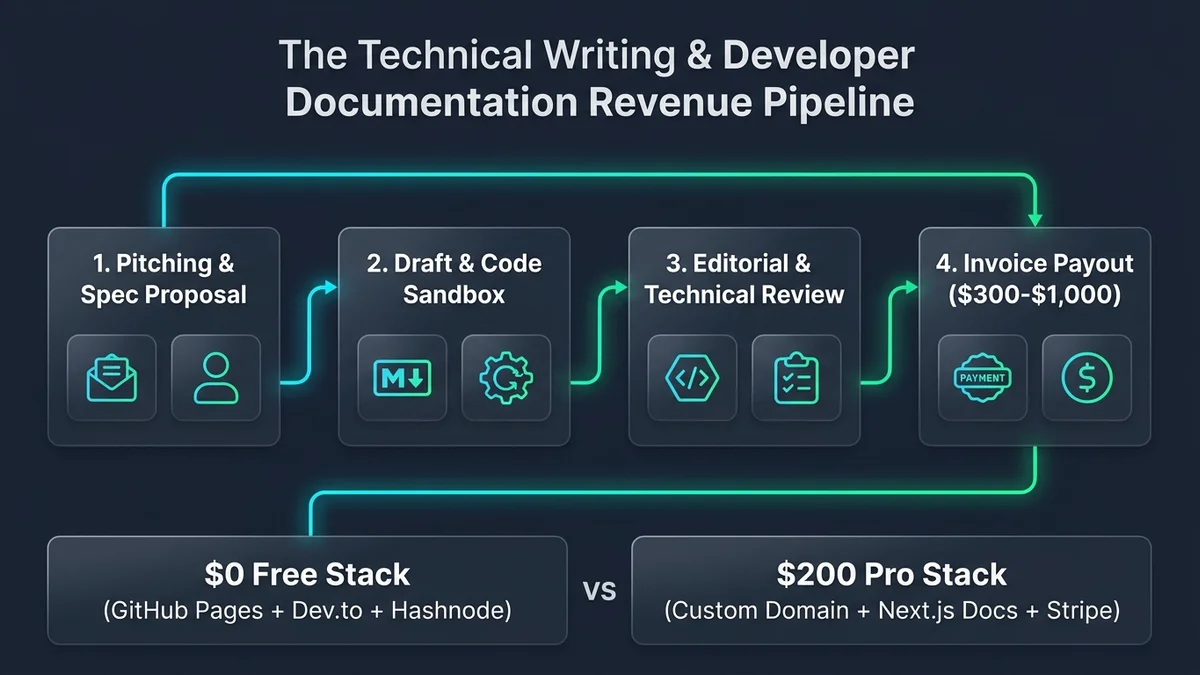
2. Real Programs Paying Developers in 2026
Here are reputable, established technical publications and DevRel agencies that regularly hire freelance technical authors:
| Publication / Company | Pay per Article | Content Topics & Focus | Submission Process |
|---|---|---|---|
| DigitalOcean Community | $300 – $500 | Linux sysadmin, Docker, Kubernetes, cloud databases | Public submission portal + editor review |
| LogRocket Blog | $350 – $600 | React, Next.js, TypeScript, frontend performance, state | Topic pitch application via blog portal |
| Draft.dev Agency | $300 – $750 | Broad dev tools, DevOps, backend systems, cybersecurity | Author network application + paid assignments |
| Smashing Magazine | $400 – $800 | Deep frontend architecture, CSS, UX engineering, WCAG | Detailed editorial outline pitch required |
| Auth0 / Okta Developer | $450 – $700 | Identity, JWT security, OAuth2, API authentication | Author pitch program form |
| Supabase / Neon Community | $300 – $600 | PostgreSQL, vector databases, serverless, full-stack | Community writer application |
3. The $0 Budget Launch Blueprint: No Prior Experience Needed
You do not need a portfolio with twenty articles to get accepted by major editors. You only need two exceptional, highly detailed writing samples that prove you write clear code and clean English. Here is the zero-dollar setup:
- Create a Free Dev.to or Hashnode Account ($0): Publish two deep technical tutorials solving a non-trivial problem (e.g. *'How to Prevent IDOR Attacks in Next.js Server Actions with Zod'*). Include working code snippets, terminal commands, and error screenshots.
- Host Code on GitHub ($0): Create a public GitHub repository accompanying each article. Editors test your code; having a clean, working repository with a well-formatted README proves your technical authenticity.
- Free Grammarly & Hemingway Editor ($0): Use free writing tools to eliminate passive voice, run-on sentences, and grammatical errors before publishing.
4. The Anatomy of a Winning Pitch Email
Never send vague pitches like: *'Hey, can I write an article about Python for your blog?'* Technical editors receive dozens of pitches daily and delete lazy proposals immediately.
A high-converting technical pitch includes a compelling title, an explanation of why their audience needs it, and a bulleted outline:
Subject: Pitch: Building a Distributed Background Worker with Redis Locks in Node.js

Hi [Editor's Name],

I would love to pitch an in-depth technical tutorial for the [Company] blog:
"How to Prevent Duplicate Job Execution in Distributed Node.js Clusters with Redis Locks"

Why it matters to your readers:
When Node.js applications scale across multi-instance cloud clusters (ECS/Kubernetes),
standard cron jobs trigger simultaneously on every container, causing duplicate billing
and race conditions. This guide teaches engineers how to implement distributed locking
with atomic Lua release scripts.

Proposed Outline:
1. The Multi-Instance Race Condition: Why standard crontabs fail in clusters
2. Acquiring the Lock: Implementing Redis SET NX with expiration
3. Atomic Releases: Using Lua scripts to prevent premature lock releases
4. Edge Case Handling: What happens when a worker crashes mid-execution
5. Complete, runnable demo repository on GitHub

Writing Sample:
You can review my recent technical breakdown on Dev.to here: [Link to your sample]

Looking forward to hearing your thoughts!

Best regards,
[Your Name] | Full-Stack Software Engineer
This structure answers every question the editor has within thirty seconds. It demonstrates that you understand the audience, have the technical solution mapped out, and can deliver a polished draft.
5. How to Structure Articles That Get Approved on First Review
To ensure editors invite you back for recurring paid monthly assignments, follow these four editorial golden rules:
- Test Every Single Code Line: Ensure your repository runs on a clean machine. If an editor runs
npm install && npm run devand it fails with a dependency error, your draft will be rejected. - Show the 'Why' Before the 'How': Don't just dump code blocks. Explain the architectural trade-offs: why you picked one library over another, and what potential production pitfalls to watch out for.
- Use Visual Callouts & Architecture Diagrams: Break up long prose with structured Markdown tables, code captions, and visual architecture diagrams.
- Adhere Strictly to the Publication Style Guide: Read the publisher's guidelines regarding heading casing (Sentence case vs Title Case), code block formatting, and link policies.
6. Summary Path to $3,000/Month as a Technical Writer
- Publish two high-quality writing samples on Dev.to or your personal site.
- Submit tailored pitches to five community writing programs.
- Once approved, write and deliver one article per week (4 articles × $500–$750 = $2,000 to $3,000/month).
- Use your paid bylines to attract direct inbound requests from funded tech startups seeking documentation and developer relations content.
Frequently asked questions
Sources

Written by
Hamza Fazal
Founder, DEESU
Muhammad Hamza Fazal is the Founder of DEESU. An Android and full-stack web developer and digital marketer based in Islamabad, he founded DEESU in May 2022 and leads its engineering operations, product strategy, and client software delivery.
More from HamzaNeed help with this?