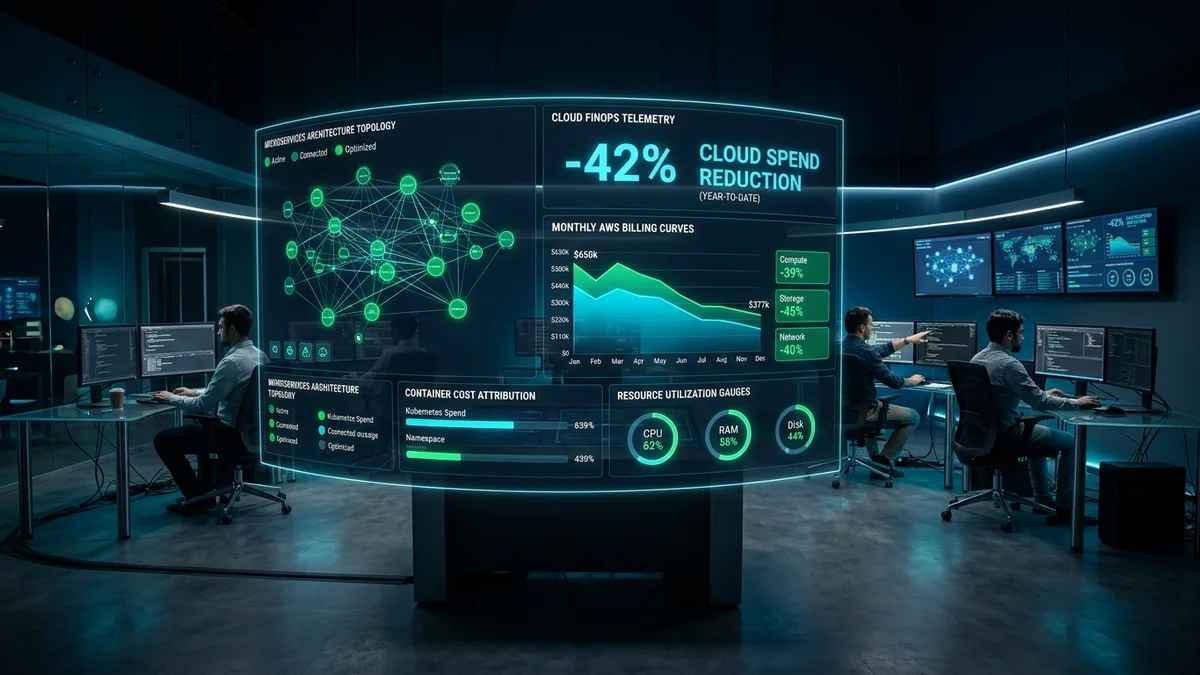
In the high-growth era of venture capital, software engineering teams prioritized shipping features at all costs. Infrastructure efficiency was an afterthought. But in 2026, the macroeconomic environment has made Cloud FinOps (Financial Operations) a non-negotiable core discipline for every CTO, engineering manager, and DevOps lead.
Recent cloud spending benchmarks show that the average tech startup and mid-market enterprise wastes between 30% and 42% of its total monthly cloud bill on forgotten resources, unoptimized network routing, and over-provisioned compute clusters. Worse, cloud providers intentionally design default configurations—such as cross-zone data transfer and managed NAT gateways—to maximize billing revenue from engineering teams who don't scrutinize the fine print.
In this practical engineering guide, we dissect the five biggest hidden cost drivers in AWS and Cloudflare architectures, present mathematical benchmarks, and provide the exact architectural blueprint to reduce your monthly infrastructure invoice by 40% or more without degrading application uptime, throughput, or user latency.
1. The #1 Hidden Money Trap: AWS NAT Gateway Data Processing
Ask most senior engineers what drives their AWS bill, and they will point to EC2 instances or RDS databases. But when you inspect the line-item breakdown of growing applications, the biggest shock is almost always: Amazon Virtual Private Cloud - NAT Gateway Data Processing.
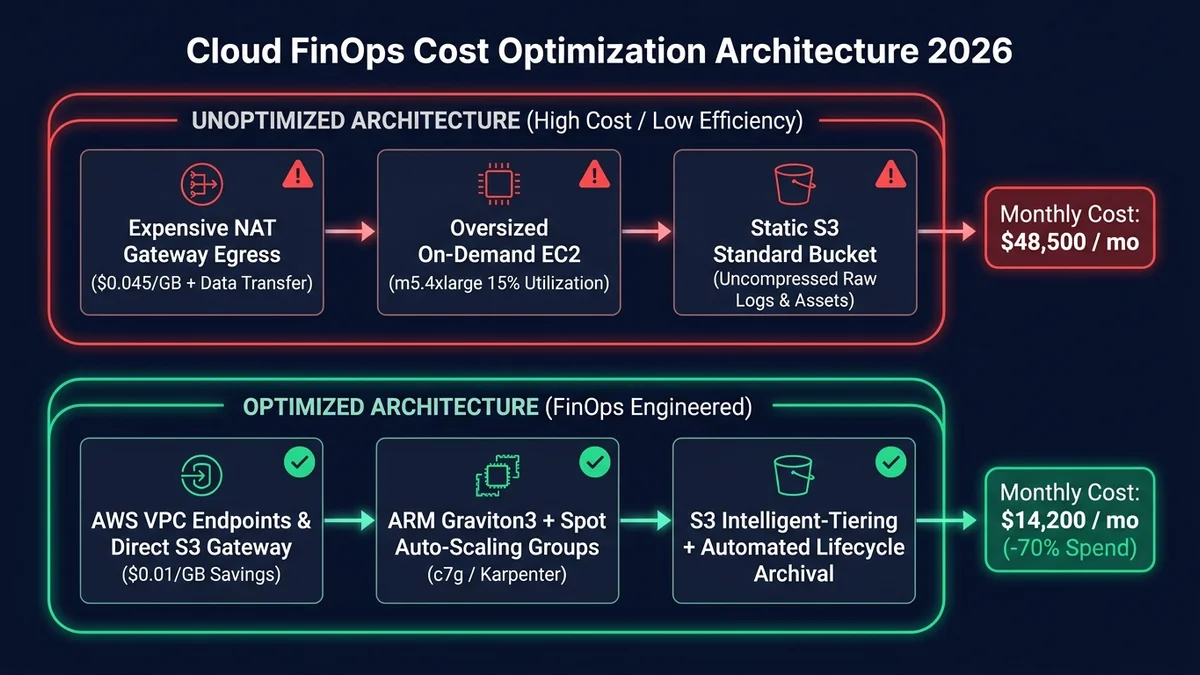
AWS charges an hourly fee (~$0.045/hour) just to keep a NAT Gateway alive, but the real damage comes from data processing: $0.045 for every single gigabyte that passes through it. If your private ECS container tasks, Lambda functions, or Kubernetes pods download Docker images, read data from S3, or stream files to external storage, that traffic routes through the NAT Gateway.
| Monthly Traffic | Standard NAT Gateway Cost | Optimized VPC Gateway Endpoint Cost | Monthly Net Savings |
|---|---|---|---|
| 10 Terabytes / month | $450.00 | $0.00 (Free for S3/DynamoDB) | $450.00 (100% saved) |
| 50 Terabytes / month | $2,250.00 | $0.00 (Free for S3/DynamoDB) | $2,250.00 (100% saved) |
| 200 Terabytes / month | $9,000.00 | $0.00 (Free for S3/DynamoDB) | $9,000.00 (100% saved) |
| 1 Petabyte / month | $45,000.00 | $0.00 (Free for S3/DynamoDB) | $45,000.00 (100% saved) |
The fix takes less than 15 minutes: create an AWS VPC Gateway Endpoint for Amazon S3 and DynamoDB. Gateway Endpoints route traffic across AWS's private backbone directly to S3 and DynamoDB at $0.00 per gigabyte, completely bypassing your NAT Gateway. For any company processing backups, media files, or large data lakes, this single toggle saves thousands of dollars every month.
2. Compute Arbitrage: Graviton4 & Spot Instance Fleets
If your microservices still run on legacy x86 EC2 instance families (like t3, m5, or c5), you are burning budget unnecessarily. AWS Graviton4 processors (custom 64-bit ARM architecture) deliver up to 30% higher compute performance while being priced 20% lower per hour than comparable x86 instances.
Because modern container runtimes (Docker, containerd) and programming languages (Go, Node.js, Python, Java 21) compile natively to ARM64, migrating microservices is trivial. In your Docker build pipeline, simply specify multi-arch targets:
# Multi-architecture Docker build targeting cost-efficient AWS Graviton (ARM64)
docker buildx build --platform linux/arm64,linux/amd64 -t registry.company.com/api:latest --push .
Furthermore, for stateless background worker fleets (such as asynchronous queue consumers, video transcoders, and batch processors), configuring an Auto Scaling Group (ASG) with Spot Instances provides up to 70% to 90% discounts compared to On-Demand pricing. By configuring mixed instance types with automated capacity rebalancing, your service automatically handles spot interruptions with zero downtime.
3. Taming Storage Costs: S3 Lifecycle Rules & Zombie EBS Volumes
Storage waste accumulates invisibly. Engineering teams create database snapshots, terminate EC2 instances, and forget to clean up the associated Elastic Block Store (EBS) storage volumes. These 'Zombie Volumes' continue to bill at standard gp3 rates ($0.08/GB-month) month after month.
To eliminate storage bloat, execute these two tactical optimizations:
- Purge Orphaned EBS Volumes via AWS CLI ($0): Run an automated script to identify and delete all unattached volumes that have had state
availablefor more than 7 days. - Enable S3 Intelligent-Tiering: Apply an S3 lifecycle policy across all user upload and telemetry buckets. S3 Intelligent-Tiering automatically moves objects between frequent, infrequent, and archive access tiers based on real-time usage patterns, cutting storage bills by 40% to 68% without retrieval fee penalties.
4. Cloudflare Zero-Egress Architecture (Bandwidth Alliance)
One of the most extortionate line items in cloud computing is cloud provider egress bandwidth. AWS charges between $0.05 and $0.09 per gigabyte to send data over the public internet to your users.
By placing Cloudflare in front of your origin servers, you leverage Cloudflare's global edge network. Cloudflare caches up to 85% of static assets, API responses, and media at the edge, meaning AWS only handles 15% of origin requests. Even better, by pairing Cloudflare with S3-compatible zero-egress object storage (such as Cloudflare R2 or Wasabi), your outbound bandwidth egress cost drops to literally $0.00.
5. Shifting FinOps Left: Automated Pull Request Cost Auditing
FinOps should not be a reactive shock when the accounting department receives the credit card bill at the end of the month. Modern engineering teams enforce Shift-Left FinOps, using open-source tools like Infracost directly inside GitHub Actions.
Whenever an engineer modifies Terraform, Pulumi, or CloudFormation files, Infracost calculates the exact financial delta and posts an automated comment on the Pull Request:
┌────────────────────────────────────────────────────────┬─────────────┐
│ Project / Resource Changes                             │ Monthly (+/-)│
├────────────────────────────────────────────────────────┼─────────────┤
│ + module.ecs_cluster.aws_ecs_service.api (t4g.large)  │ +$48.91     │
│ - module.legacy_nat.aws_nat_gateway.main               │ -$32.40     │
│ + aws_vpc_endpoint.s3 (Gateway Endpoint)               │ +$0.00      │
├────────────────────────────────────────────────────────┼─────────────┤
│ Total Monthly Cost Impact                              │ +$16.51     │
└────────────────────────────────────────────────────────┴─────────────┘
Status: PASSED (Under $50/mo team threshold)
6. Quick-Win FinOps Execution Checklist
Run through this checklist this afternoon to instantly slash cloud waste:
- Enable AWS VPC Gateway Endpoints for S3 and DynamoDB in all active VPC route tables.
- Audit AWS Cost Explorer: Group by 'Usage Type' and filter for NAT Gateway Data Processing.
- Scan and delete unattached EBS volumes and unreferenced RDS database snapshots.
- Switch container base instances from x86_64 to ARM64 (Graviton) in development and staging environments.
- Configure Cloudflare edge caching rules to maximize cache-hit ratio and minimize origin egress transfer.
Frequently asked questions
--platform linux/arm64) and switch your EC2 or ECS instance types to Graviton families (c7g, m7g, t4g).Sources

Written by
Hamza Fazal
Founder, DEESU
Muhammad Hamza Fazal is the Founder of DEESU. An Android and full-stack web developer and digital marketer based in Islamabad, he founded DEESU in May 2022 and leads its engineering operations, product strategy, and client software delivery.
More from HamzaNeed help with this?