
State management in the React ecosystem has reached an exhilarating inflection point. For nearly a decade, engineering teams treated Redux and large centralized stores as mandatory boilerplate for any application beyond a toy demo. Then came React Context, which led thousands of developers to abandon Redux—only to encounter catastrophic cascade re-render bottlenecks as their component trees expanded.
With the formal release of React 19, React Server Components (RSC), and the automatic memoization engine of the React Compiler, the architectural requirements for client-side state have completely changed. Server Components now handle 70% of what used to live in client stores: server data fetching, mutations, and cache invalidation are managed natively via useActionState and Server Actions.
What remains on the client is pure interactive state: modal states, shopping cart trays, real-time telemetry, offline form drafts, and dynamic filters. For these workloads, heavy Redux reducers and unwieldy Context providers are massive liabilities.
In this comprehensive guide, we compare the top modern state management paradigms—Zustand, Jotai, Signals, and React Context—benchmarking re-render cycles, memory footprints, and developer ergonomics in production React 19 architectures.
1. The Inherent Flaw of React Context for Dynamic State
Every senior React engineer eventually discovers the painful reality of Context: Context does not support selector-based subscriptions. When a Context provider's value changes, *every single component* that calls useContext(MyContext) is scheduled for a re-render, even if it only accesses a property that remained completely identical.
Consider a global application context holding { user, cartCount, notifications }. When the user adds an item to their cart, updating cartCount triggers re-renders across the user profile avatar, the navigation sidebar, and every active notification badge. This re-render cascade forces the browser main thread into expensive layout calculations, triggering frame drops and degrading Google Core Web Vitals Interaction to Next Paint (INP) scores on mobile devices.
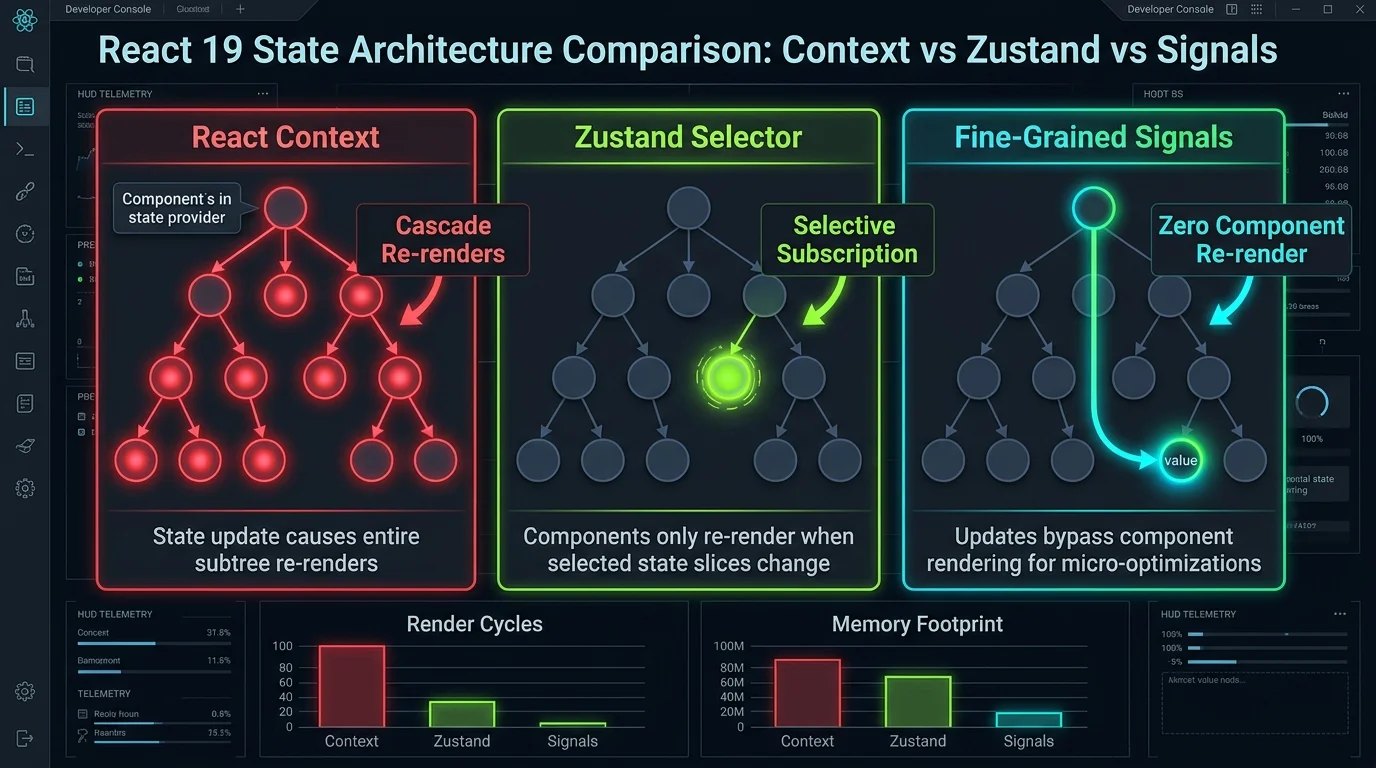
2. The Modern Contenders: Benchmark & Architecture Comparison
| Library / Pattern | Bundle Footprint | Re-render Granularity | Requires Provider? | Learning Curve |
|---|---|---|---|---|
| React Context | 0 KB (Built-in) | Coarse (Whole tree re-renders) | Yes (Nested <Provider>) | Low (Standard React API) |
| Zustand | 1.1 KB | Fine (Selective hook subscription) | No (Global store outside tree) | Very Low (Plain JS objects) |
| Jotai | 2.4 KB | Atomic (Atom-level re-render) | Optional (Provider-less default) | Moderate (Mental model of atoms) |
| Signals (Alien/Preact) | 1.6 KB | Ultra-Fine (Direct DOM text bypass) | No | Moderate (Reactive getter traps) |
| Redux Toolkit (RTK) | 11.2 KB | Fine (useSelector with equality) | Yes (<Provider store={...}>) | High (Slices, thunks, actions) |
3. Zustand: The Gold Standard for Global Interactive State
Zustand has won the hearts of the frontend community because it is brutally pragmatic. A Zustand store is simply a plain JavaScript closure that lives outside the React component tree. You do not need to wrap your application in dozens of nested Context Providers in _app.tsx or layout.tsx.
Components subscribe selectively to exact properties. If an unrelated property in the store changes, your component does not re-render:
import { create } from "zustand";
import { persist, devtools } from "zustand/middleware";

interface CartState {
  items: Array<{ id: string; name: string; price: number; quantity: number }>;
  isDrawerOpen: boolean;
  addItem: (item: { id: string; name: string; price: number }) => void;
  toggleDrawer: () => void;
}

export const useCartStore = create<CartState>()(
  devtools(
    persist(
      (set) => ({
        items: [],
        isDrawerOpen: false,
        addItem: (product) =>
          set((state) => {
            const existing = state.items.find((i) => i.id === product.id);
            if (existing) {
              return {
                items: state.items.map((i) =>
                  i.id === product.id ? { ...i, quantity: i.quantity + 1 } : i
                ),
              };
            }
            return { items: [...state.items, { ...product, quantity: 1 }] };
          }),
        toggleDrawer: () => set((state) => ({ isDrawerOpen: !state.isDrawerOpen })),
      }),
      { name: "cart-storage" }
    )
  )
);

// In a component: Subscribes ONLY to items count. Ignores isDrawerOpen changes!
export function CartBadge() {
  const count = useCartStore((s) => s.items.reduce((acc, i) => acc + i.quantity, 0));
  return <span className="badge">{count}</span>;
}
Beyond raw performance, Zustand excels in debugging transparency. By wrapping your store definition in the Redux DevTools middleware, every state transition is logged with action names, enabling instant time-travel debugging and state snapshots during complex user sessions without the overhead of Redux boilerplate.
Furthermore, because Zustand stores are decoupled from the component lifecycle, you can freely read and mutate state from outside React entirely—such as inside Axios interceptors, WebSocket message listeners, or offline service workers—via useCartStore.getState() and useCartStore.setState().
4. Overcoming the Next.js SSR Hydration Trap with Zustand
A frequent trap when using persistent client stores (such as Zustand's persist middleware storing data in localStorage) in Next.js 15 and 16 is the SSR Hydration Mismatch. When Next.js renders the HTML on the server, localStorage does not exist, so the store evaluates to its initial default state (e.g. items: []).
When the browser downloads the page and hydrates, the client store instantly reads localStorage (e.g. items: [3 items]). React detects the mismatch between server HTML and client DOM, throwing a nasty runtime warning and re-rendering the whole tree.
The architectural solution is to create a custom hydration synchronization hook using React 19's native useSyncExternalStore:
import { useState, useEffect } from "react";

// Safe hydration hook for client-persisted stores
export function useHydratedStore<T, F>(
  store: (callback: (state: T) => unknown) => unknown,
  selector: (state: T) => F
): F | undefined {
  const [isHydrated, setIsHydrated] = useState(false);
  const result = store(selector as any) as F;

  useEffect(() => {
    setIsHydrated(true);
  }, []);

  return isHydrated ? result : undefined;
}
5. Fine-Grained Signals: Bypassing the Virtual DOM
While Zustand optimizes React component re-renders through selective subscriptions, Signals take reactivity a step further: they bypass React's Virtual DOM reconciliation engine altogether.
A signal is a reactive data container. When you read a signal inside JSX, the signal library attaches a listener directly to the underlying DOM text node. When the value updates, the DOM text node is mutated immediately without running your component function, checking diffs, or evaluating child component trees.
import { signal, computed } from "@preact/signals-react";

// Global signal living outside React
export const count = signal(0);
export const double = computed(() => count.value * 2);

export function CounterDisplay() {
  // Direct DOM binding: component does NOT re-render when count.value changes!
  return (
    <div>
      <p>Count: {count}</p>
      <p>Double: {double}</p>
      <button onClick={() => count.value++}>Increment</button>
    </div>
  );
}
6. Decision Framework: Which State Solution Should You Choose?
- Use Server Components / SWR / TanStack Query: For all data that originates on a database or API. Never copy server data into global client stores.
- Use Zustand: For complex global client state requiring middleware (e.g. localStorage persistence, devtools) like shopping carts, user preferences, and multi-step modal workflows.
- Use Jotai: For fine-grained, bottom-up atomic state such as spreadsheet grids, interactive design tools (Figma-like canvases), and dynamic form builders.
- Use Signals: For hyper-performance telemetry, real-time dashboards, or crypto tickers where 60fps rendering without Virtual DOM overhead is paramount.
- Use React Context: Strictly for static or low-frequency dependency injection (such as theme toggles, i18n locales, and authenticated session tokens).
Frequently asked questions
Sources

Written by
Hamza Fazal
Founder, DEESU
Muhammad Hamza Fazal is the Founder of DEESU. An Android and full-stack web developer and digital marketer based in Islamabad, he founded DEESU in May 2022 and leads its engineering operations, product strategy, and client software delivery.
More from HamzaNeed help with this?