
In late 2024, deploying an AI feature was a game of brute force: you sent your entire user context and prompt to GPT-4 or Claude 3.5 Sonnet, absorbed the API bill, and promised your investors that model prices would eventually fall by 90%.
In 2026, prices *did* fall—yet engineering teams and startup founders are consistently shocked by monthly LLM bills running into tens of thousands of dollars. The culprit is not higher user volume. It is a fundamental misunderstanding of modern token economics.
Between asymmetric input-to-output price multipliers, the emergence of prompt prefix caching, the hidden token overhead of autonomous reasoning models (such as OpenAI o1 and o3), and multi-turn agent loops, calculating AI unit economics has become a specialized engineering discipline.
If you want to keep your product margins healthy without downgrading intelligence, you need an exact model of where your tokens are being spent. In this comprehensive guide, we dissect the 2026 LLM pricing landscape, break down the mathematical formulas behind prompt caching and reasoning tokens, and introduce production-tested routing patterns that cut AI API bills by up to 80%.
1. The Three Hidden Levers of Modern Token Billing
Historically, developers viewed an LLM as a black box that consumed N tokens and billed a single unified rate. Today, the invoice you receive at the end of the month is governed by three distinct pricing mechanisms:
Lever A: The Asymmetrical Output Penalty (4x to 10x Multiplier)
Processing input tokens is parallelizable on GPU clusters: an entire 10,000-token document can be evaluated in a single forward pass through transformer attention layers. Generating output tokens, however, is strictly autoregressive: the model must predict one token, append it to context, and run another forward pass to predict the next.
Because output generation locks GPU memory bandwidth for sequential execution, providers penalize output volume heavily. On Anthropic Claude 3.5 Sonnet, input costs $3.00 per million tokens, while output costs $15.00 per million tokens—a 5x premium. On OpenAI o1, output reaches $60.00 per million tokens.
Lever B: Prompt Prefix Caching (The 90% Discount)
In 2025 and 2026, leading model providers implemented Key-Value (KV) Cache Reuse. When an API request shares an identical prefix with recent previous queries (such as your 3,000-token system instructions, API specifications, or database schemas), the inference server skips recalculating attention matrices.
- Anthropic Claude 3.5: Cached input tokens cost $0.30/M (a 90% discount compared to the $3.00/M standard rate).
- DeepSeek-V3: Cached prompt input drops from $0.14/M to $0.014/M (a 90% discount).
- OpenAI (GPT-4o & o1): Automatic prompt caching discounts identical prefixes by 50%.
- Google Gemini 1.5: Explicit context caching allows persistent long-context storage for multi-hour sessions at fraction-of-a-cent rates.
Lever C: The 'Phantom' Cost of Reasoning Tokens
With models like OpenAI o1, o3, and Google Gemini Thinking, the model performs internal chain-of-thought exploration before drafting the final response. These internal reasoning tokens are hidden from the client in the completion text, but they are fully billed at the highest output rate ($60.00/M).
A request whose user-visible reply is only 150 tokens may have generated 4,000 internal reasoning tokens. At $60/M, that single query costs $0.25 instead of $0.005. Deploying reasoning models for straightforward tasks without token constraints is the fastest way to bankrupt an AI feature.
2. 2026 Production LLM Pricing Matrix
Below is the verified production API pricing matrix per 1,000,000 tokens across major tier-1 and open-weight models as of late 2026:
| Model | Provider | Input / 1M | Cached Input / 1M | Output / 1M | Max Context |
|---|---|---|---|---|---|
| Claude 3.5 Sonnet | Anthropic | $3.00 | $0.30 (90% off) | $15.00 | 200k |
| GPT-4o | OpenAI | $2.50 | $1.25 (50% off) | $10.00 | 128k |
| OpenAI o1 / o3 | OpenAI | $15.00 | $7.50 (50% off) | $60.00 | 200k |
| Claude 3.5 Haiku | Anthropic | $0.80 | $0.08 (90% off) | $4.00 | 200k |
| GPT-4o-mini | OpenAI | $0.15 | $0.075 (50% off) | $0.60 | 128k |
| DeepSeek-V3 | DeepSeek | $0.14 | $0.014 (90% off) | $0.28 | 64k |
| Gemini 1.5 Flash-8B | Google Cloud | $0.0375 | $0.010 (73% off) | $0.15 | 1,000k |
3. Tiered Architecture vs Monolithic Routing
The fundamental error made by inexperienced teams is monolithic routing: pointing 100% of incoming production requests to a single flagship model like Claude 3.5 Sonnet or GPT-4o.
In reality, real-world user queries follow a Pareto distribution: roughly 70% of prompts are routine (syntactic classification, user intent extraction, simple Q&A, or status updates), while only 30% require advanced logical reasoning, code generation, or nuanced empathy.
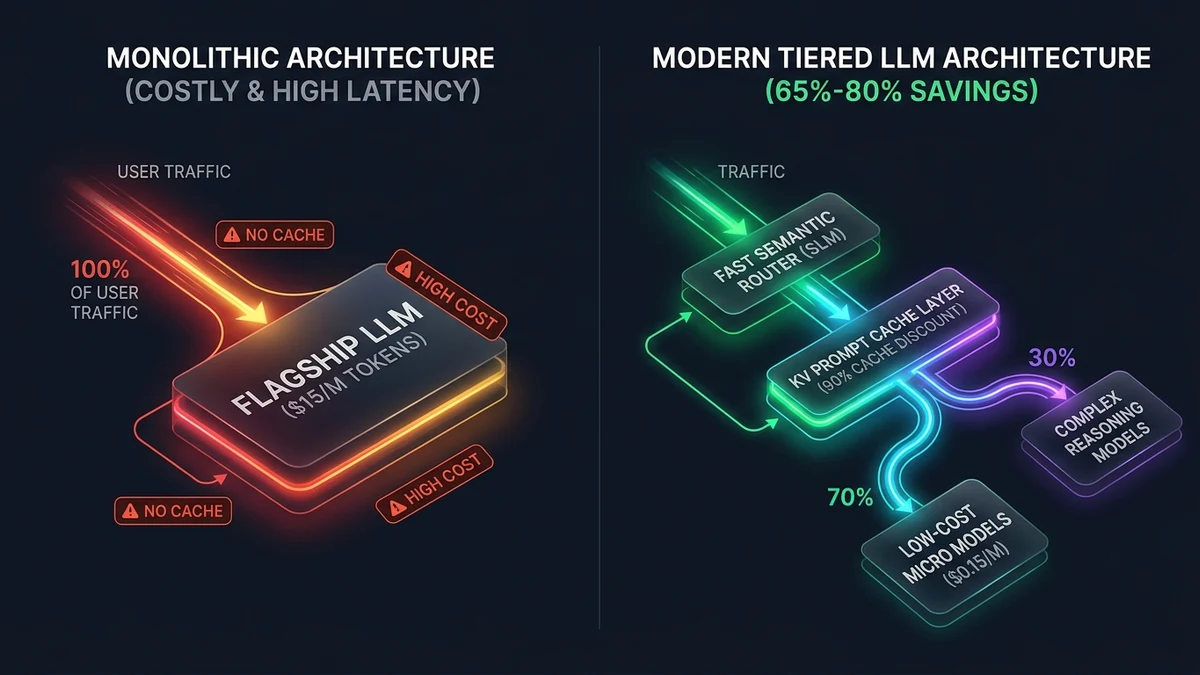
By placing a lightweight classifier (a local SLM or an ultra-cheap API like Gemini Flash-8B / GPT-4o-mini) at the edge, requests are dynamically triaged:
- Tier 1: Deterministic / Regex Guardrails: Handle 10% of spam, greetings, and unsupported prompts with zero LLM API invocation.
- Tier 2: High-Efficiency SLM (GPT-4o-mini / DeepSeek-V3): Resolves 60% of daily user requests at $0.15/M input and $0.60/M output with sub-300ms latency.
- Tier 3: Flagship Frontier LLM (Claude 3.5 Sonnet / o1): Receives only the remaining 30% of high-complexity queries requiring multi-step reasoning, mathematical deduction, or large-scale synthesis.
4. Step-by-Step Implementation: Maximizing Prompt Cache Hits
To benefit from the 90% prompt caching discount, your request structure must be deterministic. If you alter even a single character at the start of your prompt, the cryptographic hash fails, and you are billed at 100% full price.
The Golden Rule of Prompt Organization: Static First, Dynamic Last
Never place dynamic variables (such as timestamps, user IDs, or volatile search queries) at the top of your prompt. Instead, structure your prompt in strict hierarchical order:
- 1. Static System Role & Policies: The permanent behavioral guidelines (always cached).
- 2. Static Tool & API Definitions: JSON schemas and tool definitions (always cached).
- 3. Few-Shot Exemplars: High-quality input/output pairs that guide model tone (always cached).
- 4. Retrieved RAG Context: Reference documents retrieved from pgvector or search index.
- 5. Dynamic User Message & Current Timestamp: Variable elements placed at the very end.
import Anthropic from "@anthropic-ai/sdk";

const client = new Anthropic({ apiKey: process.env.ANTHROPIC_API_KEY });

// Production prompt caching implementation
export async function queryCustomerAssistant(userQuery: string, accountHistory: string) {
  const response = await client.messages.create({
    model: "claude-3-5-sonnet-20241022",
    max_tokens: 1024,
    system: [
      {
        type: "text",
        text: "You are the DEESU Platform Technical Assistant. Follow enterprise compliance rules...",
        // Instruct Anthropic to cache the static system prompt & policy guidelines
        cache_control: { type: "ephemeral" },
      },
    ],
    messages: [
      {
        role: "user",
        content: [
          {
            type: "text",
            text: `User Account Context:\n${accountHistory}\n\nQuery: ${userQuery}`,
          },
        ],
      },
    ],
  });

  // Verify prompt caching performance in telemetry
  const usage = response.usage as any;
  console.log({
    inputTokens: usage.input_tokens,
    cacheReadTokens: usage.cache_read_input_tokens ?? 0, // Billed at 90% discount ($0.30/M)
    cacheCreationTokens: usage.cache_creation_input_tokens ?? 0,
    outputTokens: usage.output_tokens, // Billed at $15.00/M
  });

  return response.content[0];
}5. Real-World Financial Simulation: 50,000 MAU Scenario
To understand the economic difference between an unoptimized deployment and a modern cached architecture, let us model a real-world SaaS company with 50,000 Monthly Active Users (MAU):
- Volume: 50,000 MAU x 5 queries/day x 30 days = 7,500,000 monthly queries.
- Average Input: 2,000 tokens (system instructions + RAG search context + query).
- Average Output: 400 tokens per completion.
- Total Token Consumption: 15.0 Billion input tokens + 3.0 Billion output tokens.
| Architecture Strategy | Input Spend | Output Spend | Total Monthly Bill | Net Savings |
|---|---|---|---|---|
| Baseline: 100% Claude 3.5 Sonnet (No Cache) | $45,000 | $45,000 | $90,000 / mo | $0 (Baseline) |
| Claude 3.5 Sonnet with 70% Prompt Caching | $16,650 | $45,000 | $61,650 / mo | $28,350 / mo (31%) |
| 3-Tier Routing (70% GPT-4o-mini + 30% Sonnet) | $14,325 | $14,850 | $29,175 / mo | $60,825 / mo (67%) |
| Tiered Routing + Prompt Caching (Optimal) | $6,210 | $14,850 | $21,060 / mo | $68,940 / mo (76%) |
By combining prompt prefix caching with multi-model routing, the total cloud invoice plummets from $90,000/month down to $21,060/month—saving over $827,000 annually without altering end-user response accuracy.
6. Summary Checklist for Production AI Engineers
- Organize all prompts strictly with static system rules and tool schemas first, dynamic user inputs last.
- Enable ephemeral cache headers (
cache_control) on Anthropic Claude or structured prefixes on OpenAI. - Implement hard limits on
max_tokensfor output generation to prevent runaway looping costs. - Use compact SLMs (DeepSeek-V3, GPT-4o-mini, Gemini Flash-8B) for classification, extraction, and triage.
- Audit reasoning models (o1/o3): ensure they are invoked exclusively on hard algorithmic or mathematical tasks.
- Set up automated cost anomaly alerts in Langfuse, Helicone, or OpenMeter to catch prompt regressions early.
Frequently asked questions
Sources

Written by
Hamza Fazal
Founder, DEESU
Muhammad Hamza Fazal is the Founder of DEESU. An Android and full-stack web developer and digital marketer based in Islamabad, he founded DEESU in May 2022 and leads its engineering operations, product strategy, and client software delivery.
More from HamzaFree tools for this topic
Need help with this?