Writing 500 lines of functional TypeScript used to take an experienced software engineer two days. In late 2026, a junior developer with an AI coding agent (Cursor, Claude Code, Windsurf) can generate that exact same code in forty-five seconds.
On the surface, this looks like the greatest productivity boom in computer science history. But inside engineering organizations around the world, an insidious crisis has taken hold: AI Code Review Fatigue. While the time required to write code has collapsed to near zero, the cognitive effort required to review, verify, and maintain that code has tripled.
Senior engineers, tech leads, and open-source maintainers are drowning. Pull request queues are backed up for weeks. Reviewers stare at sprawling 800-line diffs that look syntactically elegant and pass unit tests, yet hide subtle concurrency deadlocks, memory leak closures, and architectural anti-patterns that only surface under heavy production load.
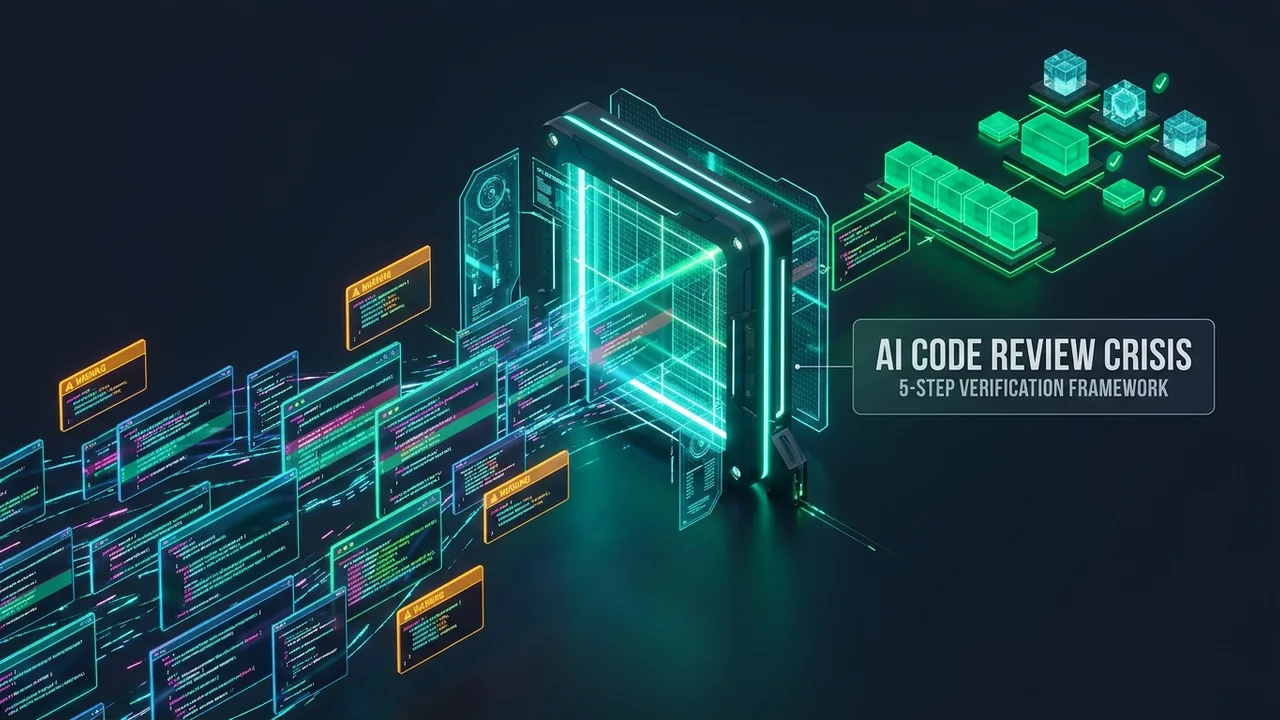
If your team feels like they are moving faster but shipping more bugs, you are not alone. In this guide, we examine the mechanics of the Reverse-Engineering Tax, explain why traditional code reviews fail for AI-generated code, and introduce the 5-Step AI Pull Request Verification Framework that production teams use to ship with speed and absolute confidence.
The Root Cause: The 'Reverse-Engineering Tax'
Why is reviewing an AI-generated pull request so much more exhausting than reviewing human-written code? The answer lies in how the human brain processes software.
When a human engineer writes code manually, their brain is constantly building a mental model of the system. They make deliberate trade-offs, test boundary conditions in their head, discard dead ends, and structure functions to reflect business intent. When a peer reviews that code, they can follow the author's linear thought process through variable naming, commit messages, and modular abstractions.
With AI-generated code, that entire mental model is missing. The author did not write the syntax—they wrote a prompt, skimmed the preview, and clicked 'Accept'. The human reviewer is hit with a Reverse-Engineering Tax:
- Cold-Start Comprehension: The reviewer must construct a mental model of 500 lines of complex code from scratch, without knowing what architectural assumptions the LLM made.
- The 'Plausibility Trap': LLMs write code that *looks* extraordinarily clean. Variable names are descriptive and TypeScript types appear strict. But beneath the polished surface, the logic often handles only the happy path, silently ignoring network timeouts, token refreshes, or race conditions.
- Ghost Dependencies & Hallucinated APIs: AI agents frequently invent function flags, import unvetted npm sub-dependencies, or duplicate existing utility functions that already exist elsewhere in your repository.
The Two Lethal Traps: Rubber-Stamping vs Velocity Freeze
When engineering teams are overwhelmed by AI-generated PR volume, they inevitably fall into one of two dangerous extremes:
Trap 1: The 'Rubber-Stamp' Outage
Faced with fifteen pending PRs and urgent product deadlines, exhausted reviewers start skimming. If the CI pipeline is green and the code looks tidy, they hit 'Approve'. Within three to six months, the codebase is contaminated with unmaintainable spaghetti, phantom memory leaks, and logic that nobody on the team understands. The first major production outage turns into a multi-day nightmare because nobody knows how the system actually works.
Trap 2: The 'Velocity Freeze'
In response to near-misses and bugs, tech leads clamp down. They demand exhaustive, line-by-line manual reviews of every single file. Senior developers stop writing features entirely and spend their entire week acting as human compilers. PRs sit in limbo for ten days, junior engineers become frustrated, and the promise of 'AI-accelerated development' grinds to a complete halt.
The Solution: The 5-Step AI PR Verification Framework
To escape both traps, modern engineering organizations do not ban AI coding tools, nor do they rely on human willpower alone. Instead, they implement an automated, specification-driven verification pipeline that shifts cognitive burden away from the reviewer.
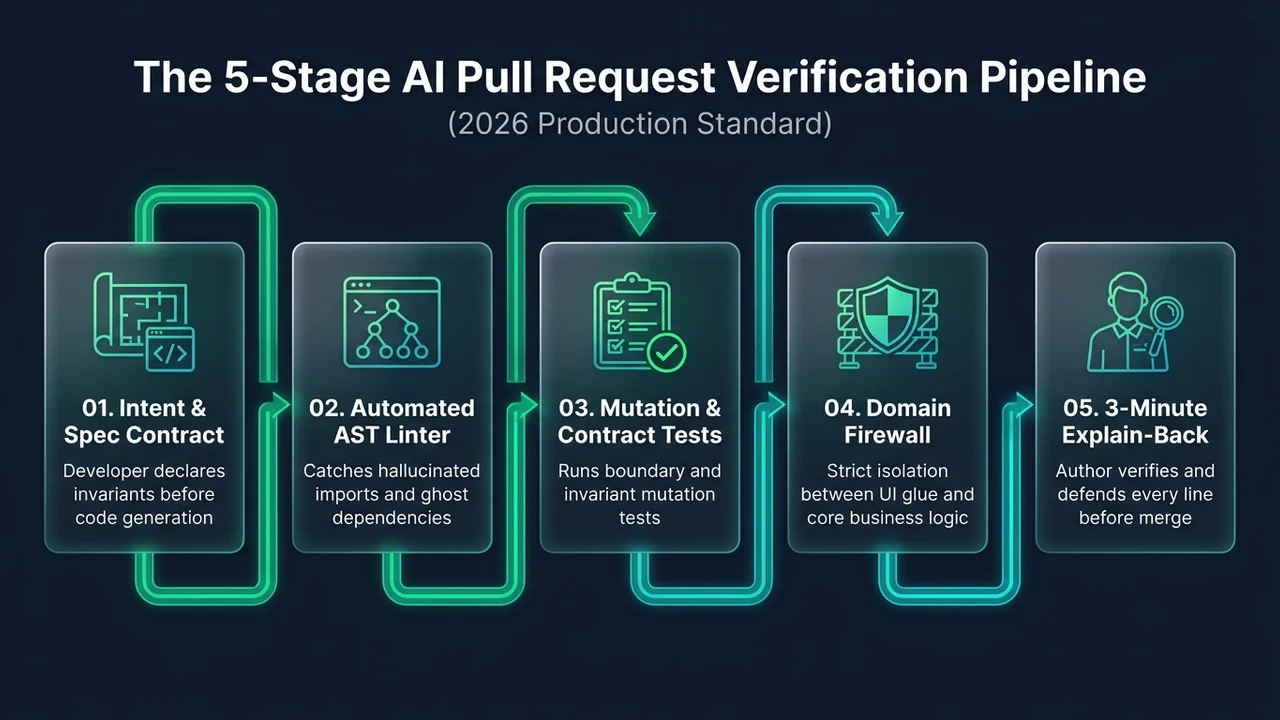
Step 1: The 'Intent & Invariants' Contract (Pre-PR Specification)
Never allow an engineer to submit an AI-generated PR with a vague description like 'Refactored auth service' or 'Added billing webhook'.
Every PR must begin with an explicit Intent & Invariants Contract declared in the PR template. Before the reviewer looks at a single line of diff, the author must explicitly state:
- What problem does this solve? (Business logic and user requirement, not code syntax).
- What are the non-negotiable invariants? (e.g., 'A customer account must never be debited twice during retries; all database queries must be wrapped in transactions').
- What did the AI want to change that you rejected? (Forces the author to prove they actively guided the model rather than blindly accepting output).
Step 2: Automated AST & Hallucination Linters
Human reviewers should never spend time checking for code formatting, hallucinated packages, or missing error handlers. That is work for machines.
Production CI/CD pipelines run automated Abstract Syntax Tree (AST) linters specifically tuned to detect AI-generated slop *before* the PR can be assigned to a human reviewer:
// scripts/ai-slop-linter.ts
// Automated CI check to catch common AI coding agent failure modes

import { Project, SyntaxKind } from "ts-morph";

const project = new Project({ tsConfigFilePath: "tsconfig.json" });
const sourceFiles = project.getSourceFiles("src/**/*.ts");

let violations = 0;

for (const file of sourceFiles) {
  // 1. Detect unhandled Promises (AI agents love floating async calls)
  const callExpressions = file.getDescendantsOfKind(SyntaxKind.CallExpression);
  for (const call of callExpressions) {
    const parent = call.getParent();
    if (
      call.getReturnType().getText().includes("Promise") &&
      parent?.getKind() === SyntaxKind.ExpressionStatement
    ) {
      console.error(
        `[AI-LINT] Floating unhandled Promise detected in ${file.getBaseName()}:${call.getStartLineNumber()}`
      );
      violations++;
    }
  }

  // 2. Detect phantom 'any' type assertions hiding schema failures
  const asExpressions = file.getDescendantsOfKind(SyntaxKind.AsExpression);
  for (const asExpr of asExpressions) {
    if (asExpr.getTypeNode()?.getText() === "any") {
      console.error(
        `[AI-LINT] Banned 'as any' bypass detected in ${file.getBaseName()}:${asExpr.getStartLineNumber()}`
      );
      violations++;
    }
  }

  // 3. Detect duplicate utility declarations (AI recreating lodash/utils)
  const functions = file.getFunctions();
  const knownBannedNames = ["formatDate", "capitalize", "slugify", "sleep"];
  for (const fn of functions) {
    const name = fn.getName();
    if (name && knownBannedNames.includes(name) && !file.getFilePath().includes("utils/")) {
      console.error(
        `[AI-LINT] Duplicate helper '${name}' created in ${file.getBaseName()}. Import from shared utils instead.`
      );
      violations++;
    }
  }
}

if (violations > 0) {
  console.error(`\n❌ Total AI slop violations: ${violations}. Fix before requesting peer review.`);
  process.exit(1);
} else {
  console.log("✅ AI AST lint checks passed successfully.");
}Step 3: Specification-Driven Testing (Human Writes Tests, AI Writes Code)
The golden rule of high-velocity engineering with AI is: Invert the workflow. Never prompt an AI to write both the production feature and its unit tests at the same time.
When an AI writes both the code and the tests, it writes tests designed to confirm its own hallucinations. The tests pass 100% of the time, yet test none of the real-world edge cases.
- Human Writes Failing Tests First (TDD): The human engineer defines the input/output boundaries, edge cases, rate limits, and expected errors in unit tests. These tests fail initially.
- AI Generates Implementation: The developer feeds the test suite and specifications to Cursor or Claude Code and instructs it to make the tests pass.
- Mutation Testing Verification: Run an automated mutation test (using tools like Stryker). If an AI-generated function can have its internal logic mutated without a test failing, the test suite is inadequate.
Step 4: Domain Architecture Firewalls
Not all code is created equal. Treating an internal Tailwind button component with the same review rigor as a database financial transaction is a recipe for team paralysis.
| Zone | Code Categories | AI Freedom Level | Review Requirement |
|---|---|---|---|
| Green Zone (Safe) | UI components, CSS styling, mock data, documentation, boilerplate CRUD forms. | High: AI agents can generate 90%+ of implementation. | 1 reviewer; focus on visual fidelity and responsiveness. |
| Yellow Zone (Controlled) | API integration glue, cache invalidation, webhook listeners, background job queues. | Medium: AI writes code against strict human-written contracts and Zod schemas. | 1 senior reviewer; automated AST checks and schema validation required. |
| Red Zone (Critical) | Stripe/payment flows, authentication tokens, encryption keys, schema migrations, core financial state machines. | Zero / Strict Human Oversight: AI forbidden from generating architectural structure; manual design required. | 2 senior staff reviewers; mandatory threat model and end-to-end integration proof. |
Step 5: The '3-Minute Explain-Back' Rule
The final safeguard is cultural, not technical: The 3-Minute Explain-Back Rule.
During synchronous review or standup, a senior reviewer can randomly select any 20-line block inside an AI-assisted PR and ask the author: *'Walk me through what happens here when the database connection drops.'*
If the author stumbles, says 'I think the AI did that', or cannot clearly explain the control flow within three minutes without re-prompting their assistant, the PR is immediately rejected. No exceptions.
Summary: The Future of Senior Engineering
The job of a software engineer in 2026 is no longer typing syntax. The job is System Verification, Architectural Governance, and Invariant Defense.
AI code review fatigue is not an inevitable consequence of artificial intelligence—it is the symptom of an outdated, manual review process trying to cope with an automated generation engine. By establishing strict Intent Contracts, automating slop detection via AST linters, enforcing domain firewalls, and maintaining a culture of deep code ownership, your team can harness the full velocity of AI without sacrificing the architectural integrity of your software.
Frequently asked questions
Sources

Written by
Hamza Fazal
Founder, DEESU
Muhammad Hamza Fazal is the Founder of DEESU. An Android and full-stack web developer and digital marketer based in Islamabad, he founded DEESU in May 2022 and leads its engineering operations, product strategy, and client software delivery.
More from HamzaNeed help with this?