When you publish a new product feature, launch a technical guide, or announce an open-source project, your first instinct is to copy the URL and share it across LinkedIn, X, Slack, and developer communities. But within seconds, you notice the failure: Slack renders a plain blue hyperlink with no image; LinkedIn pulls an old logo from two years ago; and Twitter crops your headline directly in half.
This is not an aesthetic glitch — it is a catastrophic leak in your organic acquisition funnel. User telemetry across hundreds of publishing platforms indicates that rich social cards with crisp 1200×630 visuals achieve between 2.4x and 3.8x higher click-through rates compared to raw text links. In 2026, where organic distribution is increasingly fiercely contested, failing to optimize your Open Graph protocol metadata means discarding thousands of potential visitors before they ever reach your landing page.
The Anatomy of Link Unfurling: How Modern Crawlers Read Your Page
To understand why social previews break, it helps to know what happens in the millisecond after a URL is pasted into an application. When a user pastes https://example.com/post into a chat window or post composer, the host application spawns an automated HTTP client (a scraper bot) to 'unfurl' the link.
Each platform uses a dedicated user-agent string to identify itself:
- LinkedIn:
LinkedInBot/1.0 (+http://www.linkedin.com/applicant-view/) - X / Twitter:
Twitterbot/1.0 - Facebook & Instagram:
facebookexternalhit/1.1 (+http://www.facebook.com/externalhit_uatext.php) - Slack:
Slackbot-LinkExpanding 1.0 (+https://api.slack.com/robots) - Discord:
Mozilla/5.0 (compatible; Discordbot/2.0; +https://discordapp.com) - Apple iMessage:
Applebot/0.1
Unlike a regular browser running Chrome or Safari, these scrapers do not execute client-side JavaScript (SPA bundles). They perform a lightweight GET or HEAD request, stream the raw initial HTML, parse the <head> section for <meta property="og:..." and <meta name="twitter:..." tags, and terminate the connection within 2 to 3 seconds. If your metadata relies on React useEffect() or client-side document head manipulation without Server-Side Rendering (SSR) or Static Site Generation (SSG), the crawler sees an empty HTML shell and abandons the card.
The 1200×630 Rule: Resolution, Aspect Ratio, and Retina Scaling
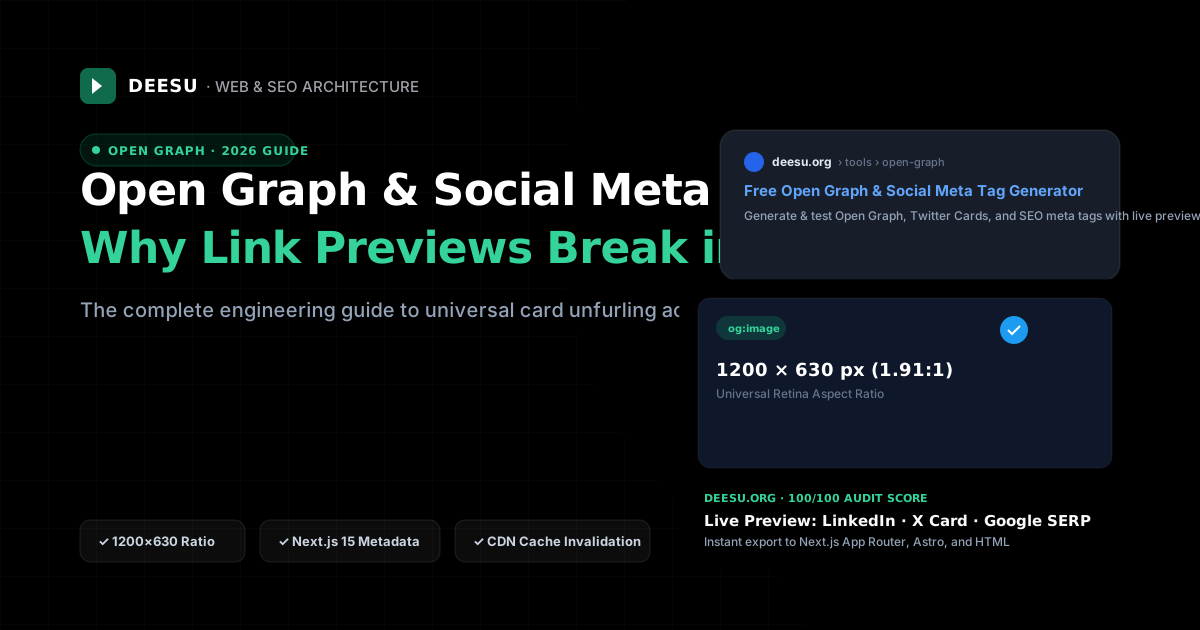
For years, the web was plagued by competing preview image standards. Today, all major platforms have standardized on one golden ratio: 1.91:1, specifically 1200 pixels wide by 630 pixels tall.
| Platform | Recommended Dimensions | Aspect Ratio | Max File Size | Card Behavior |
|---|---|---|---|---|
| X (Twitter) | 1200 × 630 px | 1.91:1 | 5 MB | Full-width banner card (summary_large_image) |
| 1200 × 630 px | 1.91:1 | 5 MB | Full-width feed card with domain and title bar | |
| Facebook / Meta | 1200 × 630 px | 1.91:1 | 8 MB | Large hero card in feed; fallback to 600×315 px |
| Slack | 1200 × 630 px | 1.91:1 | 3 MB | Large inline preview; collapses if under 400px wide |
| Discord | 1200 × 630 px | 1.91:1 | 8 MB | Rich embed with accent border and inline thumbnail |
| Google Search | 1200 × 675 px / 1200 × 630 px | 16:9 / 1.91:1 | Unlimited | Featured in Discover and mobile search carousels |
The Five Most Common Failure Modes in Production
In our engineering audits of client websites, broken link previews almost always trace back to one of five fatal implementation errors:
- Relative Image Paths: Writing
<meta property="og:image" content="/images/og.png">. Scrapers do not resolve relative URLs against your root domain. An Open Graph image must always be a fully qualified, absolute HTTPS URL:https://deesu.org/images/og.png. - Bot Blocking & Cloudflare Challenges: Aggressive Web Application Firewalls (WAF) or Cloudflare's 'Bot Fight Mode' often classify
facebookexternalhitorTwitterbotas suspicious automated scrapers, serving them an HTTP 403 Forbidden or a Cloudflare Turnstile challenge. Always whitelist legitimate social crawler user-agents. - Missing Twitter Card Directive: Even if you have all Open Graph tags declared, X (Twitter) requires
<meta name="twitter:card" content="summary_large_image">. Without this explicit line, X defaults to a tiny 144×144 square thumbnail or suppresses the image entirely. - Oversized Image Assets: Exporting uncompressed 15 MB PNG files. Scraper bots enforce strict download timeouts (typically 2 to 4 seconds) and hard memory limits (3 MB to 5 MB). If your image does not stream within that window, the crawler aborts and shows no visual.
- Redirect Chains and Trailing Slash Mismatches: If your link is
https://site.com/blog/my-postbut your web server issues a 301 redirect tohttps://site.com/blog/my-post/, some scrapers will not follow the redirect and simply fail.
The Caching Trap: Why Changing Code Doesn't Update Social Feeds
The single most common complaint developers voice when fixing meta tags is: *'I updated my HTML, deployed to production, but LinkedIn still shows the broken old preview!'*
Social networks cannot afford to re-crawl every shared URL each time a user scrolls their feed. When a URL is shared for the first time, the scraper downloads your metadata and caches the compiled card on their edge servers for anywhere from 7 days to 30 days.
To force an immediate cache purge, you must use each platform's official developer debugger:
- LinkedIn Post Inspector: Navigate to
linkedin.com/post-inspector, paste your URL, and click 'Inspect'. This flushes LinkedIn's CDN cache instantaneously. - Facebook Sharing Debugger: Open
developers.facebook.com/tools/debug, enter the URL, and click 'Scrape Again'. If the image was changed, click it twice to clear image dimension caches. - X / Twitter: The legacy Twitter Card Validator no longer supports manual re-scrapes. To force X to fetch new metadata, append an arbitrary query parameter to your shared link (e.g.
https://yourdomain.com/post?v=2). - Telegram: Send the URL directly to the official
@WebpageBotin the Telegram app and tap 'Update preview'.
Modern Framework Implementations: Next.js 15 App Router vs HTML
If you build with modern web frameworks, you no longer need to maintain messy <head> blocks manually. In Next.js 14 and 15 (App Router), you export a typed Metadata object from any layout.tsx or page.tsx file:
import type { Metadata } from "next";

export const metadata: Metadata = {
  title: "Open Graph & Social Meta Tags in 2026",
  description: "The complete engineering guide to universal card unfurling across Google, X, and LinkedIn.",
  alternates: {
    canonical: "https://deesu.org/blog/open-graph-meta-tags-social-preview-guide-2026",
  },
  openGraph: {
    title: "Open Graph & Social Meta Tags in 2026",
    description: "The complete engineering guide to universal card unfurling across Google, X, and LinkedIn.",
    url: "https://deesu.org/blog/open-graph-meta-tags-social-preview-guide-2026",
    siteName: "DEESU",
    images: [
      {
        url: "https://deesu.org/blog/open-graph-meta-tags-social-preview-guide-2026.svg",
        width: 1200,
        height: 630,
        alt: "Open Graph & Social Meta Tags Guide 2026",
      },
    ],
    locale: "en_US",
    type: "article",
  },
  twitter: {
    card: "summary_large_image",
    title: "Open Graph & Social Meta Tags in 2026",
    description: "The complete engineering guide to universal card unfurling across Google, X, and LinkedIn.",
    creator: "@deesu_org",
    images: ["https://deesu.org/blog/open-graph-meta-tags-social-preview-guide-2026.svg"],
  },
};For dynamic pages (such as e-commerce products or CMS-backed blog articles), use Next.js's generateMetadata() function to query your database and return dynamic Open Graph attributes before server rendering.
Open Graph in the Age of AI Search (ChatGPT, Perplexity, and Gemini)
In 2026, social networks are no longer the only consumers of Open Graph metadata. Modern conversational AI search engines — including ChatGPT Search, Perplexity AI, Google Gemini, and Claude Search — crawl the web constantly to synthesize answers.
When an AI engine answers a user prompt and cites your website as an authoritative source, it parses og:title, og:description, og:image, and og:site_name to construct the visual citation pill shown in the chat response. Websites that provide rich, verified Open Graph data and matching Schema.org JSON-LD enjoy significantly higher citation rates and referral traffic from AI answer engines than sites with missing or unvalidated metadata.
Frequently asked questions
Sources

Written by
Hamza Fazal
Founder, DEESU
Muhammad Hamza Fazal is the Founder of DEESU. An Android and full-stack web developer and digital marketer based in Islamabad, he founded DEESU in May 2022 and leads its engineering operations, product strategy, and client software delivery.
More from HamzaFree tools for this topic
Need help with this?