For years, mobile app founders and software teams lived under a simple, non-negotiable rule: if a user purchased digital content, subscriptions, or consumables inside an iOS or Android app, Apple and Google took an uncompromising 30% cut. Following landmark antitrust litigation, the Epic Games settlement, and regulatory mandates like the European Union's Digital Markets Act, that monopoly has fractured. Both Google Play and the Apple App Store now legally permit external payment links, web-based checkout flows, and alternative third-party in-app billing engines in major global markets.
The immediate reaction from developers was euphoric: bypass the app stores, plug in Stripe or Paddle at 2.9%, and pocket the remaining 27%. But as hundreds of subscription apps and SaaS founders have discovered when auditing their monthly payouts in late 2026, the real-world math tells a startlingly different story. External billing is frequently not cheaper — and for millions of low-cost mobile subscriptions, routing users to an external website checkout actually drains your monthly take-home profit.
The Baseline: How Native Store Commissions Actually Work
Before evaluating alternative checkout flows, it is critical to understand what developers actually pay when using native Google Play Billing or Apple StoreKit in 2026. The myth that 'every app pays 30%' is outdated:
- The 15% Small Business Program: Both Google and Apple reduce their baseline cut from 30% to 15% on the first US$1,000,000 in eligible gross revenue every calendar year. Over 98% of active mobile developers qualify for this rate.
- The 15% Permanent Subscription Rate: Google Play charges a flat 15% on all recurring auto-renewing subscriptions from day one, regardless of whether you have passed the $1M annual ceiling. Apple charges 30% in year one, dropping permanently to 15% for any subscriber retained past 12 months (or 15% from day one if enrolled in the Small Business Program).
- Merchant of Record Inclusion: For that 15%, Apple and Google handle international sales tax, VAT, and GST calculation and remittance across 170+ territories, absorb credit card processing interchange fees, manage chargeback fraud, and provide 1-tap biometric checkout (FaceID / Fingerprint) that converts visitors at rates unachievable on the open web.
The Myth of Fee-Free External Links: Google and Apple Still Take Their Cut
When a developer incorporates an external payment link (such as a 'Subscribe on our Website' button or an alternative in-app billing provider like Stripe), Google Play and Apple do not wave goodbye to their commission. Instead, both platforms assess a reduced service fee on external transactions originating from app store users.
In the European Economic Area, the UK, and South Korea, Google Play discounts its platform commission by only 3% to 4%. This means an app in the 15% tier is charged an 11% platform service fee by Google for the privilege of routing that user to an external link. In the United States, under Google's External Content Links program, Google charges an ongoing service fee of 20% to 25% (or 10% on qualifying renewals).
The Real Math: Side-by-Side Financial Comparison
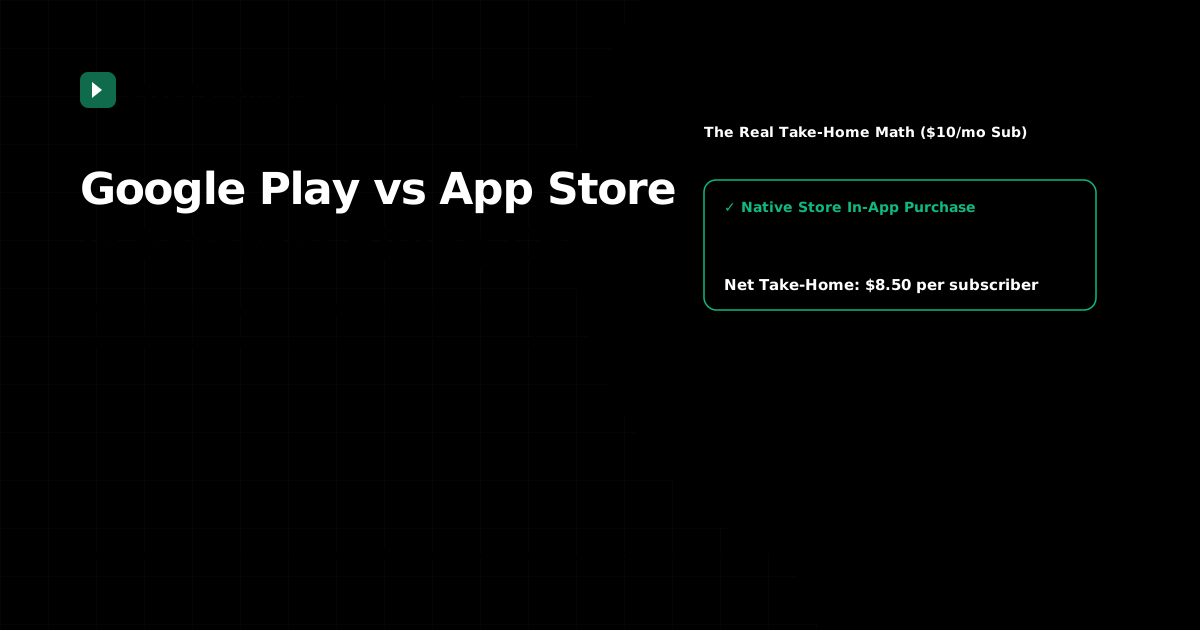
To illustrate where the economics break down, let us compare the exact take-home payout across four common consumer price points ($4.99/mo, $9.99/mo, $29.99/mo, and $99.99/yr). We assume Google Play's 15% subscription tier against an external Stripe checkout at 11% Google service fee + 2.9% + $0.30 Stripe processing.
| Plan Price | Native IAP (15%) | External Platform Cut (11%) | Stripe Fee (2.9% + 30¢) | Raw External Net | With 15% Redirect Drop-off | Winning Choice |
|---|---|---|---|---|---|---|
| $4.99 / mo | $4.24 (85.0%) | $0.55 | $0.44 (8.8%) | $4.00 (80.2%) | $3.40 (68.1%) | Native IAP (+24.7% profit) |
| $9.99 / mo | $8.49 (85.0%) | $1.10 | $0.59 (5.9%) | $8.30 (83.1%) | $7.06 (70.6%) | Native IAP (+20.2% profit) |
| $29.99 / mo | $25.49 (85.0%) | $3.30 | $1.17 (3.9%) | $25.52 (85.1%) | $21.69 (72.3%) | Native IAP (+17.5% profit) |
| $99.99 / yr | $84.99 (85.0%) | $11.00 | $3.20 (3.2%) | $85.79 (85.8%) | $72.92 (72.9%) | Context Dependent |
The Hidden Factors Most Financial Models Ignore
Looking strictly at transaction fee percentages ignores three massive operational headwinds that routinely erase external billing margins:
- The 30-Cent Fixed Fee Trap: On a $4.99 micro-subscription or consumable pack, Stripe's flat $0.30 fee represents a staggering 6.0% of the entire purchase. Combined with the 2.9% percentage cut, card processing alone eats 8.9% of your gross before Google's 11% fee is even touched.
- Checkout Redirect Friction: Pushing a mobile user out of a native Android or iOS app into an external browser requires them to re-enter email addresses, manually type 16-digit credit card numbers, and authenticate SMS codes. Industry benchmark data across mobile e-commerce confirms a 12% to 22% conversion drop-off compared to native biometric 1-tap Google Pay / Apple Pay authorization.
- Tax and Compliance Overhead: Inside native store billing, Google and Apple act as the Merchant of Record, automatically calculating and remitting sales tax in all 50 US states, European VAT, and Asian GST. On external web checkout, that burden shifts to you, necessitating paid tax automation services (like Stripe Tax or Avalara) costing an additional 0.5% per transaction.
- Fraud and Chargeback Dispute Costs: On the web, stolen cards and fraudulent chargebacks trigger a $15.00 dispute fee from card networks, plus the loss of the product. Google Play and Apple absorb payment fraud risk natively.
When DOES External Billing Actually Make Sense?
Despite the drawbacks for low-cost consumer apps, external payment links are immensely valuable in specific architectural scenarios:
- High-Ticket Annual Plans ($100 to $500+): On a $300 annual SaaS license, Stripe's $0.30 fixed fee is a microscopic 0.1%. Saving 4% on platform commission translates to real cash ($12+ per transaction), justifying the checkout redirect.
- Cross-Platform Desktop & Web SaaS: If 80% of your customer base already registers and enters credit cards on your web application (e.g., Slack, Notion, Figma), mobile app users are simply logging into existing accounts with zero store commission applied.
- B2B and Invoiced Accounts: Corporate clients who require custom invoices, purchase orders, or bank transfers (ACH/SEPA) that cannot be routed through consumer app store accounts.
- Consolidated Customer Support: Teams that already maintain full-time billing support desks and prefer unified customer refund management under a single Stripe dashboard.
The Bottom Line for 2026 App Publishers
If you operate a mobile-first B2C consumer app monetizing via $4.99 to $14.99 monthly subscriptions, native Google Play Billing and Apple StoreKit are overwhelmingly more profitable than routing users to an external website. The 15% small business and subscription rate offers extraordinary value when factoring in 1-tap conversion velocity, zero chargeback exposure, and automated international tax compliance.
Reserve external checkout links for premium annual tiers, enterprise upgrades, or established web-first SaaS products. For everything else, focus your engineering resources on optimizing your onboarding funnel and retention curves rather than building complex, drop-off-prone external checkout bridges.
Frequently asked questions
Sources

Written by
Hamza Fazal
Founder, DEESU
Muhammad Hamza Fazal is the Founder of DEESU. An Android and full-stack web developer and digital marketer based in Islamabad, he founded DEESU in May 2022 and leads its engineering operations, product strategy, and client software delivery.
More from HamzaFree tools for this topic
Need help with this?